
Polarization and Democratic Fragility
Written by Francesco Coghi and Bennett Iorio
“Something has gone wrong with democracy.” That’s the claim, made with grandiloquence or in not so many words, across the globe. Not necessarily uniformly, nor everywhere, not irreversibly, and certainly not in the same way in every country - but the pattern is visible enough, and widespread enough, that it can no longer be read as a series of national accidents.
Democracies that seemed consolidated have produced constitutional crises. Institutions that seemed robust have been captured or hollowed out or resigned to irrelevance. Leaders who seemed unelectable have won, and once in office have treated the constraints of democratic governance as obstacles to overcome, often with alarming alacrity. The V-Dem project, which tracks democratic quality across more than 170 countries, recorded in its 2025 Democracy Report a sustained wave of autocratization that now affects a larger share of the world's population than at any point since the dark days of fascism in the 20th century - with the level of democracy enjoyed by the average world citizen declining to now to 1985 levels (Nord et al., 2025). The “democratic recession” is not a metaphor nor indeed just received wisdom. It actually shows up in data.
And yet, this is not the first time democratic systems have been tested to breaking point: Italy's republic survived over a decade of coordinated political violence during the Years of Lead without suspending democratic institutions; the United States removed the criminally abusive Nixon through constitutional mechanisms alone; West Germany's postwar democracy withstood both the RAF's campaign of terror and the long shadow of its own catastrophic past. That these systems held is not a reason for complacency - the conditions that allowed self-correction then are precisely what is now under pressure.
The explanations on offer are not in short supply either. Economists point to decades of stagnant wages, rising inequality, and the visible failure of democratic governments to deliver material improvements for working populations. Political scientists identify institutional weaknesses - constitutional designs that were never stress-tested, party systems that have fragmented under pressure, legislatures that have ceded authority to executives in what political scientist Nancy Bermeo (Bermeo, 2016) influentially termed 'executive aggrandizement' - the incremental, legal-seeming process by which elected leaders weaken institutional checks one by one. Technologists often claim that the Information Age has made previous modes of societal engagement ineffective or obsolete. Sociologists trace cultural resentments and the politics of identity. Geopolitical analysts predictably note the erosion of the international order that once buffered democratic governance from sustained external shock. Each of these accounts captures something real; it’s not to say they’re wrong. None of them, though, taken alone, explains why the pattern is so widespread, so simultaneous, and so visible across societies with very different histories, institutions, and social compositions; a convergence that has led comparative scholars to argue that the current wave of democratic erosion is structurally distinct from earlier episodes precisely because its drivers are multiple and simultaneous (Lührmann and Lindberg, 2019; Norris and Inglehart, 2019).
The Standard Claim and the Outcome of Our Study
That simultaneity is the worrying puzzle. Local conditions vary enormously, of course; what holds across countries is the pressure - the sense that democratic institutions are struggling to function as they were designed to, that the gap between democratic procedure and democratic outcome has widened, and that publics have noticed. Something in the shared operating environment of democratic governance has changed.
One candidate stands out from the others, both in the frequency with which it is invoked and in the specificity of the causal story attached to it: Political polarization, intensified and amplified by the digital information environment, advanced perhaps most influentially by Sunstein (2017).
The argument has become something close to orthodoxy in policy and media circles. Algorithmic platforms reward outrage and segment audiences into sealed ideological environments; the mechanisms behind this are well documented: Recommendation algorithms filter content according to prior engagement, systematically narrowing users' informational exposure into what Pariser (2011) terms 'filter bubbles' - ideologically homogeneous environments that amplify existing beliefs and reduce encounter with opposing views. Disinformation spreads faster than corrections. Social media has replaced the shared informational commons on which democratic deliberation depends. Artificial intelligence is now lowering the cost of convincing false content toward zero; realistic audio fabrications, synthetic video, and personalised political manipulation are now achievable at negligible marginal cost, a dynamic that amplifies the asymmetry between production and verification described in what has become known as Brandolini's Law - the principle that the energy required to refute misinformation is an order of magnitude greater than the energy required to produce it (Brandolini, 2014; Thatcher et al., 2018; Iorio and Lyrestam, 2026) The result, on this account, is a democratic public that is more hostile, less able to sustain cross-cutting compromise, and more susceptible to leaders who treat the enemy-logic of polarization as a political resource. This diagnosis has generated a corresponding policy prescription that has become near-orthodox in regulatory and academic circles on both sides of the Atlantic (Sunstein, 2017; Runciman, 2018; Persily and Tucker, 2020): Fix the platforms, restore the information environment, and democratic stability follows breezily.
It is a coherent narrative. It has the virtue of identifying a villain and a mechanism, and it connects readily to a policy agenda. And it is not wrong in its component parts. Algorithmic incentives do reward hostility. Disinformation does circulate widely. AI does lower the cost of manipulation. These things are real. Research has confirmed that exposure to social media can increase affective polarization - the mutual antipathy between partisan groups - even when it does not straightforwardly shift underlying ideological positions (Bail et al., 2018; Rathje et al., 2021).
The question is whether they are the right causal story - or, in other words, whether the amplification narrative, stated in its standard form, actually explains the democratic erosion we can observe. Because if it does not, or only partially does, then a policy conversation organised around it will systematically misallocate attention and effort.
Democratic breakdown, when it comes, tends to announce itself through visible events. An election result is contested and not conceded. A parliament is suspended. A coup is attempted. A constitutional constraint is removed by decree. These are the moments that generate headlines and historical datelines; the before and after of democratic failure, in a sense.
But the events themselves are rarely the story. By the time a democracy produces a January 6th, a Bolsonaro mobilising his military, a Yoon Suk-yeol declaring martial law, the underlying conditions have been accumulating for years. As Lührmann and Lindberg (2019) demonstrated in their foundational study of the 'third wave of autocratization', contemporary democratic breakdown is characterised by gradual, legal-seeming decline rather than sudden rupture - making it both harder to identify and harder to arrest. Democratic systems do not collapse from single shocks. They erode. Capacity degrades. Trust dissolves. Institutions that once constrained executive power begin to look like obstacles rather than safeguards, and are treated accordingly. The terminal event, when it arrives, is less a cause than a symptom.
Understanding what that structural process looks like - what drives it, how it develops - is therefore not only an academic question. It is a practical one. If democratic fragility is the product of identifiable, measurable dynamics, then those dynamics can in principle be tracked, interrupted, and addressed before they reach the point of rupture.
This Commentary addresses that question using evidence. It reports the findings of a systematic descriptive analysis of political polarization and democratic erosion across 179 countries from 2000 to 2024, drawing on the Varieties of Democracy project (Coppedge et al., 2025), the Episodes of Regime Transformation dataset (Maerz et al., 2024), and external measures of digital infrastructure and the online information environment - internet penetration data, for example, were drawn from Our World in Data (2024) and the World Bank World Development Indicators (2024), both of which provide consistent, externally validated country-year series covering the full analysis period. The analysis was designed to test not one but several versions of the technology-amplification hypothesis, and to identify which parts of the standard narrative hold up descriptively and which do not.
The findings are specific. Political polarization - the organisation of politics around mutually hostile camps that perceive one another not as competitors but as enemies - is robustly and consistently associated with democratic erosion. That finding holds across multiple methods and multiple ways of looking at the data. It is the clearest macro-level signal in the evidence.
The technology story is more complicated, and the complications matter. Digital infrastructure does not behave as a simple amplifier of democratic collapse risk. In the data, highly connected democracies are among the most stable. A narrower information-dynamics measure - combining online media fragmentation with government domestic disinformation - also fails to produce the expected amplification pattern. These findings do not mean technology is democratically benign. They mean that the simplest version of the amplification narrative is not supported, and that the real relationship between technology, polarization, and democratic fragility is more conditional and institutionally mediated than the dominant conversation assumes.
Thus, the argument this Commentary will make. It begins with what the evidence shows, proceeds through what the evidence does not show and why that matters, and ends with what follows for democratic governance.
What Was Measured
Before asking what the data show, it is worth being honest about what the data actually are. This matters not as a bureaucratic caveat, but because the strength of any empirical claim depends directly on the nature of the evidence behind it - and because one of the methodological choices made in this analysis turns out to be substantively important for how the findings should be read.
The primary source for political variables was the Varieties of Democracy dataset, version 15, covering 179 countries across the period 2000 to 2024 (Coppedge et al., 2025). V-Dem is the most comprehensive cross-national democracy dataset currently available, and its coverage of both democratic quality and the political information environment made it the natural foundation for this project. The main democracy measure used was V-Dem's Liberal Democracy Index (VDem Libdem) - a continuous indicator that captures not only whether elections occur, but whether the broader architecture of liberal-democratic governance is intact: constraints on executive power, protection of civil liberties, rule of law, and related institutional safeguards. Think of it as a summary measure of democratic health rather than merely democratic procedure.
The polarization measure (VDem P) was V-Dem's indicator of hostile political camps; a variable designed to capture the degree to which politics is organised around antagonistic blocs that perceive each other not as legitimate competitors but as enemies to be defeated or destroyed. This is the conceptual core of the analysis; it maps onto what McCoy, Rahman, and Somer (2018) call 'pernicious polarization', in other words, the specific dynamic in which political identity collapses into a zero-sum Us versus Them logic, emasculating cross-cutting ties and making compromise feel like betrayal. It is not a measure of ideological distance between parties, though that matters too; it is a measure of the enemy-perceiving quality of political conflict - the dynamic that makes compromise feel like betrayal and electoral defeat feel like an existential threat.
Both of these variables are expert-coded. That means they are not derived from raw behavioural data - vote counts, protest records, economic statistics - but from structured assessments by country specialists, aggregated and calibrated through a measurement model. This is both V-Dem's great strength and the source of a methodological concern that must be named clearly. When the same pool of experts is assessing both democratic quality and polarization in the same country-year, their perceptions can move together not because the phenomena are independently causing one another, but because experts observing a deteriorating political environment will tend to score both variables accordingly. A country that looks more hostile, more institutionally degraded, more contemptuous of constraint will register higher polarization and lower democracy simultaneously in the expert assessments. The association is real - it reflects a real political reality - but it cannot be interpreted as a causal relationship between the two.
This concern does not invalidate the findings. It shapes how strongly they should be stated. The analysis treats the polarization-democracy association as a robust descriptive pattern, not as demonstrated causation. That is the appropriate level of claim for a descriptive phase, and it is the level maintained throughout this Commentary.
The concern also shaped one of the key methodological choices: the use of internet penetration - the share of a country's population with access to the internet, drawn from Our World in Data and World Bank sources - as an external, non-expert-coded measure of the digital environment. Internet penetration is a blunt instrument. It does not directly capture algorithmic amplification, disinformation pressure, or platform-driven narrative fragmentation. But precisely because it is an external, rather than an expert judgement, it provides a genuinely independent test of the infrastructure dimension of the technology-amplification story. That independence turned out to matter considerably for what the analysis found.
The information-environment measures came from V-Dem's Digital Society Project module, which provides expert-coded country-year indicators of online media fragmentation and government domestic disinformation. These are conceptually closer to the mechanism that the amplification narrative actually proposes - a fragmented, manipulation-saturated information environment that intensifies political antagonism - but they carry the same expert-coding caveat as the other V-Dem variables.
Finally, the analysis used the Episodes of Regime Transformation (Maerz et al., 2024) dataset to identify autocratization events: the specific country-years in which a democratic breakdown episode began. This variable was crucial. Year-on-year changes in a democracy index are small and noisy; they obscure as much as they reveal. Aligning country trajectories around the onset of a genuine regime-deterioration episode - asking what polarization looked like in the five years before a democracy began to break down, compared to countries where no such event occurred - produces a sharper and more interpretable picture. The ERT dataset identified 93 such events in the period 2000 to 2024. That is the empirical core around which the most important findings of this analysis are built.
One further restriction matters for interpretation. Several of the tests were conducted only on baseline democracies - countries that met a minimum threshold of democratic quality at the start of the analysis period, around the year 2000. This restriction is analytically sensible, because questions about democratic erosion are most meaningful when the country starts from a democratic baseline rather than from an already-authoritarian condition. It also means the findings speak specifically to the democratic world's vulnerability to its own internal dynamics - which is precisely the question this Commentary is asking.
The data have limitations, and they will be noted where they bear on specific findings. But they are sufficient - in coverage, in consistency, and in the range of variables available - to test the polarization and amplification hypotheses in a rigorous descriptive way. What follows is what they show.
What the Global Trends Show
The broadest view of the data is also the clearest. Across the 179 countries in the analysis, two global trends run through the period 2000 to 2024 in opposite directions, and their divergence is not subtle.
Global average liberal democracy rose modestly through the first decade of the century, reaching its peak around 2010 (see Fig. 1(a)). From that point, it declined - steadily, monotonically, and without reversal. By 2024, average democratic quality across the sample had fallen below its 2000 starting level. The V-Dem Democracy Report 2025 confirms the scale of this reversal: as of 2024, there are now 91 autocracies in the world and only 88 democracies - the first time autocracies have outnumbered democracies in more than two decades (Nord et al., 2025). In short, the democratic gains of the post-Cold War period had not merely stalled. They had gone into reverse.
Over the same period, global average political polarization rose in the opposite direction. It increased monotonically from the start of the analysis period to the end, with no plateau and no reversal (see Fig. 1(b)). This trend is consistent with cross-national survey evidence: Boxell, Gentzkow, and Shapiro (2024), studying twelve OECD countries over four decades, found that “affective polarization” or “partisan mutual antipathy” - has risen substantially in most advanced democracies, with the United States experiencing the largest increase of all, though the pattern is far from uniform. The relationship between the two trends is not a coincidence of timing. It is visible in the data at multiple levels of analysis - in the global aggregates, in within-country correlations, and most clearly of all in the event-aligned trajectories examined in the next section. Across the full sample, higher polarization is associated with lower democratic quality at the country level with a correlation of approximately -0.43. That is a substantial association in cross-national political data.
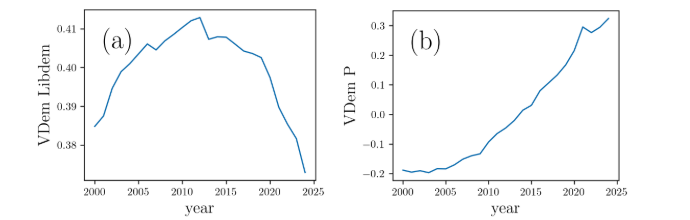
Fig. 1: (a) Global average V-Dem expert-coded liberal democracy index (VDem Libdem) and (b) Global average V-Dem expert-coded polarization index (VDem P), plotted against time from 2000 to 2025.
It is worth pausing on what this global picture does and does not establish. The co-movement of the two trends is real and it is consistent with the hypothesis that polarization contributes to democratic erosion. But aggregate global trends cannot establish mechanism. It is worth recalling that both the polarization measure and the Liberal Democracy Index are expert-coded variables drawn from the same V-Dem assessment framework, which means their co-movement may partly reflect shared expert perceptions of a deteriorating political environment rather than fully independent empirical signals.
Many things changed between 2000 and 2024. The period includes the 2008 financial crisis, the rise of social media, the acceleration of economic inequality across the democratic world, the return of great-power geopolitical competition, and much else besides. Global time series, as also shown for a sample of countries in Fig. 2, move together for reasons that raw trend data cannot disentangle. The aggregate picture is the starting point for the analysis, not its conclusion.
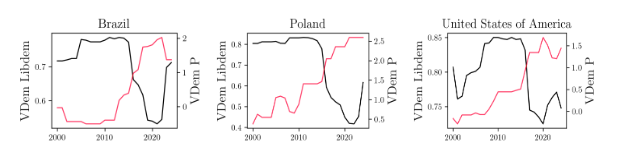
Fig. 2: Three countries as illustrative examples of the dynamical changes of V-Dem liberal democracy index (VDem Libdem in black solid) and V-Dem polarization index (VDem P red solid).
What the global trends do establish, clearly and without ambiguity, is that the hypothesis is worth examining. The world has become more polarized and less democratic at the same time. That pattern is real. The question is what is driving it, how the two dynamics relate to one another, and whether the technology environment through which so much political life now flows has changed or intensified the relationship between them.
The next section addresses that question using the sharpest available tool in the analysis: what happens to polarization in the years immediately before a democracy breaks down.
The Event Evidence: What Happens Before Democracies Break
Aggregate trends and theory are suggestive, but event evidence – that is, the real world examples – are compelling.
The Episodes of Regime Transformation dataset identifies 93 country-years between 2000 and 2024 in which a democratic breakdown episode began - moments when a functioning democracy started, measurably and subsequently verifiably, to come apart (Maerz et al, 2024). These are not close calls or ambiguous cases. They are the onset points of genuine autocratization: the year the slide began. Aligning every country's political trajectory around its own onset year, and asking what polarization looked like in the five years before that moment compared to the five years after, produces an important finding in this analysis.
It’s simply this: Polarization rises, clearly, consistently, and substantially, in the years preceding democratic breakdown.
At five years before onset, the average polarization score among autocratizing countries stood at approximately 0.23 on the standardised scale used in this analysis - already above the global mean. At one year before onset it had reached 0.35. At onset itself it was 0.49. It continued rising in the years that followed, reaching 0.63 by five years after onset. The trajectory is not a spike around a single moment of crisis. It is a sustained escalation - a years-long accumulation of political antagonism that precedes and then outlasts the formal breakdown event. This pattern is consistent with the scholarly consensus that contemporary democratic erosion is a gradual process rather than a sudden rupture (Bermeo, 2016; Levitsky and Ziblatt, 2018). Democratic collapse, on this evidence, does not come out of nowhere. It is preceded by a prolonged period in which politics reorganises itself around mutually hostile camps, and the willingness to treat opponents as legitimate competitors within a shared system progressively dissolves.
The contrast with non-autocratizing countries makes this finding vivid. Among the 104 countries in the sample that experienced no autocratization onset after 2000, polarization levels across the same window tell a different story entirely. These countries registered average polarization scores of approximately -0.37 at five years before the placebo alignment point, -0.28 at the midpoint, and -0.11 at five years after - negative throughout, meaning consistently below the global mean (cf. with Fig. 1(b)). Their democracy levels measured by index VDem Libdem, meanwhile, held stable at around 0.44 across the full window, neither rising dramatically nor declining (cf. with Fig. 1(a)). Stable democracies are not merely less polarized than autocratizing ones at a single moment. They are consistently, structurally less polarized across the entire period of observation.
That is the central empirical finding of this analysis, and it deserves to be stated plainly: the single clearest descriptive separator between democracies that broke down and democracies that did not, across 179 countries and 24 years of data, is political polarization. A necessary caveat applies: Polarization is itself an expert-coded variable, and its rise may reflect the downstream effects of the very economic and institutional pressures the analysis elsewhere identifies - a limitation the descriptive design of this study cannot resolve, and which causal modelling with primary observable variables would be needed to untangle (Alesina and Glaeser, 2004; Gidron, Adams and Horne, 2020). This is in some ways a useful finding. It also resonates with McCoy and Somer's (2019) comparative analysis of eleven polarized polities, which found that pernicious polarization consistently precedes and accompanies democratic erosion regardless of the specific institutional setting in which it occurs. The organisation of politics around enemy-perceiving, mutually hostile camps that cannot sustain the basic premise of democratic competition - that losing an election is not an existential catastrophe - is the variable that most consistently precedes and accompanies democratic failure.
This finding connects directly to the framework advanced in GIEF's foundational work on democratic stability. Democratic self-correction - the capacity of a political system to identify failure, absorb criticism, and revise course without rupture - depends on a shared epistemic baseline and a political culture in which defeat is understood as reversible rather than terminal. When polarization reaches the levels visible in the pre-breakdown trajectories here, both of those conditions are already severely compromised. Epistemic capacity degrades because the two camps no longer share enough common ground to sustain a democratic conversation. Decision capacity stalls because legislative compromise becomes politically toxic. Execution capacity weakens because institutions are increasingly treated as factional instruments rather than shared infrastructure. By the time the formal breakdown event occurs, the functional capacities of democratic governance have often already been hollowing out for years.
None of this settles the question of what produces polarization at these dangerous levels in the first place. The data establish the association between polarization and breakdown with considerable robustness. They do not, at this level of analysis, resolve the causal story upstream - whether polarization of this character and intensity is itself being driven or amplified by technological change, by economic stress, by geopolitical disruption, or by some combination of all three. That question is the one the next two sections turn to directly.
Technological Acceleration: What the Evidence Does and Doesn't Show
The claim that digital technology amplifies polarization into democratic collapse is, at this point, close to a received wisdom in policy circles. It organises regulatory debates about platform liability, content moderation, and algorithmic accountability. It underpins arguments for breaking up large technology companies, mandating transparency in recommendation systems, and treating social media as a public health problem. It has generated a substantial and growing literature, a cottage industry of think tanks and advocacy organisations, and - in the European Union's Digital Services Act and related legislation - a significant body of law.
It may still be correct in important respects. But the cross-national data do not support its simplest and most policy-relevant form. And the way in which it fails is instructive.
The first test used internet penetration (also simply denoted IntPen in the plots below) - the share of a country's population with access to the internet (World Bank 2024, Our World in Data 2024) - as a measure of digital infrastructure. If technology amplifies the relationship between polarization and democratic collapse, the expectation is straightforward: among countries with high polarization, those with greater digital connectivity should show higher rates of democratic breakdown. More internet reach, on this account, means more exposure to the algorithmic dynamics that intensify political antagonism, which means greater democratic risk when polarization is already elevated.
Yet, the data produce a different pattern.
Among the 85 baseline democracies examined in the final contingency analysis, the group combining high polarization with low internet penetration autocratized at a rate of 75 per cent. The group combining high polarization with high internet penetration autocratized at a rate of 47 per cent. High connectivity, among already-polarized democracies, was associated with lower autocratization incidence, not higher. The most stable group in the entire analysis was low polarization combined with high internet penetration, with an autocratization rate of under 4 per cent. The least stable was high polarization combined with low connectivity.
The event-aligned trajectories reinforce this picture. In the five years before autocratization onset, internet penetration in breakdown countries was consistently below the global average. It rose gradually over the window - reflecting the broad global diffusion of connectivity rather than any pre-crisis digital shock - but never approached the levels seen in stable democracies. Stable democracies, in this data, are more digitally connected than autocratizing ones, not less.
The structural reason for this pattern is important to understand, because it is not a vindication of digital technology as a democratizing force. It is a development story. Internet penetration is strongly correlated with GDP per capita (as shown in Fig. 3(a) and (b)), educational attainment, and institutional quality. High-connectivity countries tend to be wealthy, institutionally robust democracies - Scandinavian countries, Western Europe, parts of East Asia - where democratic consolidation preceded mass digital access and where institutional resilience is itself a product of long-run development. Of course, in a sense that’s unsurprising; it’s consistent with broader findings in the development literature: Stronger institutions tend to be more resistant to destabilising pressures of all kinds (Acemoglu and Robinson, 2012). But it certainly is not cause to celebrate or conclude that technological acceleration is a red herring; that’s not borne out by data. Rather, the infrastructure-amplification hypothesis failed not because digital technology is benign, but because connectivity is so deeply entangled with the very factors that make democracies stable in the first place. Trying to isolate a negative amplification effect from that bundle, using internet penetration as the measure, is not analytically possible with this data, and trying to do so would miss the forest for the trees. It’s of course a relief that autocratization or democratic backsliding aren’t directly correlated with internet penetration or technological connectivity – that would be a dire result indeed. But this finding should not be understood to say that technological acceleration helps democracy necessarily – not at all. Rather, it should best be understood as a complex amplifier, both of connectivity (which is positively correlated with democratic resilience), and also of all other information modalities and channels, some of which may and indeed are potentially deleterious to democracy.
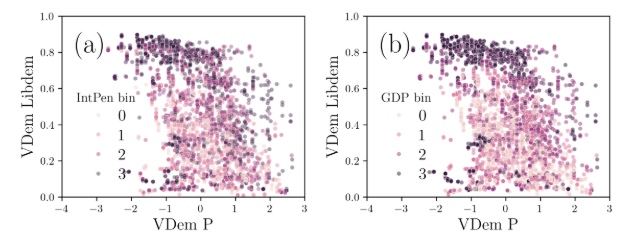
Fig. 3: (a) Internet penetration index (IntPen) and (b) GDP, both binned in 4 colored classes and plotted against V-Dem liberal democracy index (V-Dem Libdem) and V-Dem polarization index (V-Dem P).
In short, the data does not show that technological acceleration directly produces democratic breakdown - that finding would require the connectivity measures to predict autocratization, and they do not. What the data show instead is more conditional: highly connected democracies are more stable on average, but that stability is inseparable from the institutional quality and economic development with which connectivity is bundled. The question of whether technology independently destabilises democratic institutions - operating beneath the level of full autocratization - requires evidence the cross-national panel data used here cannot supply. That evidence exists, but comes from outside this study: Guriev, Melnikov and Zhuravskaya (2021), using a difference-in-differences design with an instrumental variable across 116 countries, find that mobile broadband expansion causally reduces confidence in government and increases populist vote share, with the effect concentrated in weaker institutional environments. This is not a finding of the present analysis. It is cited here as independent causal evidence that technology's destabilising effect on institutional trust is real, measurable, and institutionally conditional - consistent with, but not derived from, the patterns this study identifies. The combined picture is genuinely mixed: connectivity supports democratic stability at the macro level while simultaneously, and causally, eroding the institutional trust on which that stability depends. That tension is not a contradiction to be resolved; it is the actual relationship between technology and democracy that the evidence, taken together, supports. Yet connectivity, as we have seen, reinforces institutional trust and supports democracy. A mixed bag indeed.
This recognition prompted a second, more targeted test – one designed to get closer to the mechanism that the amplification narrative actually proposes.
Rather than asking whether connectivity amplifies collapse risk, the second test asked whether the quality of the information environment does. Using V-Dem's Digital Society Project module, an information amplifier index was constructed from two components: online media fragmentation - the degree to which the online information space is divided into ideologically distinct, non-communicating spheres - and government domestic disinformation, capturing the extent to which state actors actively seed false or manipulated information into the public sphere. These two variables were selected because they correspond most directly to the mechanisms identified in the academic literature as potentially harmful to democratic epistemic capacity: the fragmentation of shared information environments and the active degradation of public discourse by state actors (Runciman, 2018; Harari, 2024). These two variables are conceptually much closer to the amplification mechanism than infrastructure reach. If technology destabilises democracy through epistemic fragmentation and strategic manipulation, this index should capture it.
The 2×2 analysis of baseline democracies again produced a striking result, but not the expected one.
Among high-polarization democracies, those with a high information amplifier score autocratized at a rate of 30 per cent. Those with a low information amplifier score autocratized at 76 per cent. The group most expected to show democratic collapse - high polarization combined with a fragmented, disinformation-saturated information environment - was not the most vulnerable. It was the second most stable among the high-polarization groups. Once again, polarization was the dominant risk variable. Once again, the information environment did not function as a simple structural amplifier.
These findings require careful interpretation, because what they do not mean matters as much as what they do.
They do not mean that disinformation is unimportant. They do not mean that epistemic fragmentation is democratically harmless. They do not mean that algorithmic platforms have no effect on political culture, that AI-generated content poses no threat to the informational foundations of democratic governance, or that the concerns animating GIEF's own programme on technological instability are misplaced. Those concerns remain well-founded, and the evidence base supporting them - drawn from platform-level research, case studies, and the documented effects of specific disinformation campaigns - is substantial and serious.
What the cross-national data do mean is that the simplest macro-level version of the amplification story is not supported. Technology does not appear to function, at the country-year level, as a universal structural force that predictably converts polarization into autocratization regardless of institutional context. The relationship is more conditional than that. And that conditionality is itself analytically important: it points toward institutions, rather than technology, as the critical mediating variable. A fragmented information environment in an institutionally robust democracy produces different outcomes than the same environment in a democracy whose self-correcting mechanisms have already been severely weakened. The question then becomes not merely how bad the information environment is, but what institutional conditions determine whether a democracy can absorb that pressure or succumb to it.
That is a more complicated and in some ways more demanding policy conclusion than "fix the platforms." It is also, on the available evidence, the more accurate one.
What the Data Cannot Settle
The findings of the previous two sections establish something useful and something uncomfortable in roughly equal measure. Useful: a clear, robust, multi-method empirical signal that polarization of the enemy-perceiving variety consistently precedes and accompanies democratic breakdown. Uncomfortable: the absence of support, in macro cross-national data, for the amplification narrative that currently dominates the policy conversation on technology and democracy.
But a descriptive analysis of this kind has limits, and those limits are not merely technical footnotes. They bear directly on what conclusions can and cannot be drawn, and on what the next phase of work - both empirical and political - needs to address.
The first and most important open question concerns what the data cannot see. Country-year panel data captures national-level averages across time. What it cannot capture is the platform-level, within-society dynamics through which technology actually operates on political culture. The claim that algorithmic recommendation systems intensify affective polarization, that they reward outrage and punish moderation, that they create asymmetric information environments in which hostile political content spreads faster and further than accurate or conciliatory content - none of this is tested or refuted by the cross-national analysis reported here. Research at the platform level has produced genuinely mixed findings: Bail et al. (2018) found that exposure to opposing views on social media can actually increase ideological polarization, not reduce it; Guess et al. (2023) found that in a randomised experiment, removing the Facebook algorithm's feed-ranking reduced time spent on the platform but had limited measurable effects on political attitudes. The null result on internet penetration and information fragmentation is a result at the macro level. It leaves the micro-level mechanisms entirely open.
This distinction matters particularly for GIEF's broader argument about technological acceleration as a driver of democratic instability. The case for that argument does not rest primarily on the claim that connectivity predicts autocratization in cross-national data. It rests on a more specific and more mechanism-focused set of observations: that the information environment democratic institutions now have to operate within has changed qualitatively, not just quantitatively; that the incentive structures of major platforms systematically reward the political dynamics - hostility, identity signalling, enemy-construction - that the macro data shows are most dangerous to democratic health; and that artificial intelligence is now lowering the cost of epistemic manipulation toward zero in ways that no previous communications technology has done; as per Vosoughi, Roy and Aral (2018), who demonstrated empirically that false news spreads significantly faster, further, and more broadly than accurate information across social media platforms - a finding that sits alongside the aforementioned Brandolini's Law to form a compound structural problem that disinformation is cheap to produce, travels fast, and is expensive to correct (Brandolini, 2014; Thatcher et al., 2018). Importantly, the deployment of generative AI on a massive scale since 2022 represents a qualitative shift that is not captured in the V-Dem data used here, which largely predates its mass adoption. Yet these claims are not falsified by the findings reported here. They simply operate at a level of granularity that country-year data cannot reach.
The second open question concerns heterogeneity. The analysis treats the 179 countries in the sample as a single population and asks about average patterns. But the relationship between technology, polarization, and democratic fragility may not be uniform across that population. It may matter substantially whether a democracy is already institutionally weakened before the information environment degrades. It may matter whether the degradation happens rapidly or gradually. It may matter whether it occurs in a context of economic stress, geopolitical pressure, or both simultaneously - the convergence of pressures that GIEF's foundational framework identifies as the distinctive feature of the present moment. The descriptive phase of this analysis pointed in this direction conceptually but did not fully stratify by institutional strength, regional context, or historical period. A post-2010 subsample analysis, for instance, might produce different results from the full 2000–2024 window, given that the most consequential shifts in platform architecture and AI capability are concentrated in the latter half of that period.
The third open question is the most fundamental, and it is the one that connects the empirical findings most directly to the policy stakes. The data establish that polarization is strongly associated with democratic breakdown. They do not establish what produces polarization at the levels and character that make it dangerous. That upstream causal question - why some democracies develop the enemy-perceiving, compromise-refusing political culture that the event-aligned trajectories show is so consistently present before breakdown - is precisely where the technology argument re-enters with full force.
It is entirely consistent with the findings reported here that digital technology - specifically, the algorithmic incentive structures of major platforms and the AI-accelerated collapse in the cost of disinformation - is one of the primary mechanisms through which dangerous polarization is generated and sustained. The cross-national data cannot rule that out. They cannot even meaningfully test it, because the causal pathway would run from technology to polarization to breakdown, and the analysis only captures the second half of that chain. That the data are silent on the upstream link is not the same as endorsing it; but it is equally not grounds for dismissing it. If platforms are systematically producing the kind of affective, identity-fused, enemy-perceiving political antagonism that the event evidence shows is so destructive, then the macro finding that connectivity does not directly predict breakdown is entirely compatible with technology being a critical upstream driver. The danger would be in the polarization, and the polarization would be - in part - the product of the information environment.
That is the intellectually honest reading of what the descriptive phase has and has not established. It does not vindicate the amplification narrative in its standard form. It does not dismiss the technology concern. It locates the technology question more precisely: not as a simple structural amplifier that converts polarization into collapse, but as a potential producer of the political conditions - the hostile camps, the fractured epistemic commons, the collapse of shared reality - that the data show are genuinely dangerous to democratic health.
Resolving that upstream question requires different evidence: causal modelling with adequate controls, platform-level data on content dynamics and political behaviour, and more fine-grained measures of how the information environment interacts with institutional quality across different democratic contexts. The descriptive phase reported in this Commentary was explicitly not designed to answer that question. It was designed to establish whether the basic descriptive patterns justify the investment in that more demanding analysis. They do.
What Follows for Democratic Governance
The findings of this analysis do not point toward a simple policy conclusion. They point toward a reorientation - a shift in where attention and institutional energy are directed, and a more precise understanding of what democratic resilience actually requires.
Start with what the evidence most clearly supports. Polarization - not in the ordinary sense of political disagreement or ideological divergence, but in the specific sense of politics organised around mutually hostile camps that perceive each other as existential enemies - is the dominant macro-level correlate of democratic erosion. It precedes breakdown. It accompanies breakdown. It continues escalating after breakdown has begun. Democracies that avoided autocratization over the 24-year period of this analysis were, consistently and structurally, less polarized than those that did not. That finding is robust enough to anchor a policy conversation.
The implication is that democratic resilience depends, in significant part, on the political and institutional conditions that sustain or reduce polarization of this character. That is a different emphasis from the one that currently dominates. An enormous proportion of the policy energy directed at democratic fragility is focused on the downstream symptoms - disinformation content, platform algorithms, specific electoral vulnerabilities - rather than on the upstream conditions that determine whether a democracy can absorb these pressures or be destabilised by them. The evidence suggests the upstream conditions deserve more attention than they currently receive.
Those conditions are institutional. They include electoral systems that create incentives for coalition building rather than base mobilisation; legislative designs that require negotiation across factional lines; independent judiciaries and administrative bodies whose authority is not contingent on partisan loyalty; public broadcasters and civic institutions that maintain some shared informational space across political divides; and - most fundamentally - a political culture in which losing an election is understood as a temporary setback rather than a civilisational defeat. The importance of these institutional foundations has been documented extensively in comparative political science: Levitsky and Ziblatt (2018) trace the erosion of norms of mutual toleration and institutional forbearance as the proximate mechanisms through which democracies die; Ginsburg and Huq (2018) show how constitutional design shapes a democracy's capacity to resist executive encroachment.None of these are in and of themselves novel observations. What the cross-national evidence adds is a sense of their comparative weight: these structural conditions appear to matter more to democratic survival than the information environment alone.
But this is precisely where the analysis must be read against the broader context of democratic instability in which it sits - and where intellectual honesty requires resisting a tempting but incomplete conclusion.
The absence of a simple amplification signal in cross-national data does not mean technology is not part of the problem. It means technology is not the whole problem, and not a sufficient explanation on its own. It suggests, rather, that technology may enter the causal chain at an upstream level - to be clear, not as a direct structural accelerant of autocratization, but potentially as a contributory factor to the polarization that the data shows is the proximate mechanism of democratic breakdown. GIEF's foundational argument about the drivers of democratic instability identifies technological acceleration as one of three converging structural pressures - alongside climate-driven stress and geopolitical fragmentation - that have jointly altered the operating environment of democratic governance over the past two decades. That argument is not undermined by the findings here. It is, if anything, sharpened by them.
The sharpening works as follows. The data establish that dangerous polarization - which drives enemy perception and lowers capability to compromise - is the proximate mechanism through which democratic fragility manifests at the macro level. What the data cannot establish, but what studies and analysis of how the algorithms driving this technology may suggest, is that the current information environment is one of the primary engines generating and sustaining that kind of polarization. More specifically: Algorithmic platforms do not merely reflect political hostility; their incentive structures actively reward it. The outrage dynamic is not incidental to platform economics - it is central to them. Facebook's own internal research, revealed through the 2021 Facebook Papers, found that the platform's engagement-optimising algorithm promoted content that elicited anger and outrage above other emotional responses (Horwitz, 2021). The platform-level evidence is suggestive and serious - independent research confirms that algorithmic incentive structures actively reward political hostility, that out-group animosity drives engagement above all other content types, and that Facebook's own internal research found its algorithm systematically amplified anger over other emotional responses (Rathje, Van Bavel and van der Linden, 2021; Horwitz, 2021) - but suggestive evidence of mechanism is not the same as demonstrated macro-level causation. Simultaneously, these are not background or niche conditions. They are active forces operating on the political culture of every democracy as one of the main modalities of holding the “democratic conversation” between citizens, at a scale and speed that no previous communications technology has approached.
This is the instability dynamic that matters most in the present moment. Not that technology directly causes autocratization in a mechanical, country-by-country way that shows up cleanly in aggregate data. But that it operates as a continuous, global-scale pressure on the epistemic and social foundations that democratic governance requires - degrading the shared informational commons, intensifying affective political antagonism, lowering the cost of manipulation for anyone willing to use it, and doing all of this across every democracy at once, with no unaffected periphery and no natural ceiling. The V-Dem 2025 report notes that almost half of all autocratizing countries are increasingly spreading disinformation domestically, and that political polarization is increasing in a quarter of all countries worldwide (Nord et al., 2025). The simultaneous character of the current democratic recession - the puzzle identified at the opening of this Commentary, that societies with very different histories and institutions have weakened in parallel - remains only partially explained by existing evidence, and no single factor has been demonstrated to account for it. Cross-national research shows that affective polarization has risen in most but not all advanced democracies, with significant variation in timing and magnitude that a simple global-platforms explanation does not fully account for (Boxell, Gentzkow and Shapiro, 2024). Nevertheless, the hypothesis that shared global platforms operating on the same attention-maximising logic have contributed to this parallel deterioration remains plausible and consistent with the pattern in the data - it simply has not yet been conclusively established.
Policy Recommendations
The policy implications that follow from this framing are more demanding than the standard platform-regulation agenda, though they include it.
The political conditions that produce and sustain dangerous polarization deserve explicit attention as a democratic resilience priority. This means taking seriously the institutional designs that create incentives for enemy-construction - electoral systems that reward base mobilisation over coalition-building, media ecosystems that profit from outrage, campaign finance structures that amplify the voices of factional extremes. Reducing polarization pressure requires intervening in the conditions that generate it, not only in the platforms that amplify its expression.
Platform accountability and algorithmic transparency are justified and necessary - but they should be pursued on the correct grounds. The case for intervention in platform incentive structures is not primarily that connectivity predicts autocratization in cross-national data. It is that the incentive structures of major platforms systematically produce the political dynamics that the data shows are most dangerous to democratic health. That is a more precise and more defensible argument than the broad amplification narrative, and it connects more directly to specific, actionable regulatory interventions.
The AI dimension requires urgent and separate attention in the form of government oversight commissions. The findings of this analysis were generated using data that largely predates the mass deployment of generative AI. The period under examination captures the social media era but only the earliest phase of AI-generated content at scale. The collapse in the cost of convincing disinformation, synthetic media, and personalised political manipulation that generative AI now enables represents a qualitative shift in the instability pressure on democratic epistemic capacity - one that the cross-national data available today cannot yet adequately measure, and one that the policy and regulatory frameworks currently in place are nowhere near adequate to address. The EU AI Act, which entered into force in 2024, is a beginning; though by nature of rapidly changing technology, it is not sufficient and will rapidly become obsolete without update (European Union, 2024). What is needed alongside it is a standing international mechanism for iterative AI governance - one that can update regulatory requirements in pace with capability development; the OECD's 2024 revision of its AI Principles, which for the first time explicitly addresses generative AI, disinformation, and information integrity, points toward the kind of interoperable, regularly updated international framework that the democratic stakes of this problem require (OECD, 2024). This is the frontier of the technology-democracy problem, and it is moving faster than the institutions designed to govern it.
The convergence of pressures matters as much as any individual driver. The instability facing democratic governance is not the product of technology alone, or economic inequality alone, or geopolitical disruption alone. It is the product of all three (and others) operating simultaneously on institutional systems that were not designed for this configuration. The practical implication is specific: Existing democratic resilience architecture - electoral commissions, constitutional courts, media regulators, competition authorities, national security bodies - was built to address these pressures separately and sequentially, not simultaneously. What the convergence demands is a standing cross-domain resilience function within democratic governments: A body with the mandate and authority to identify when pressures are compounding, to coordinate responses across institutional silos, and to act before individual thresholds are breached. Finland's cross-government hybrid threats preparedness model, which integrates security, information environment, and institutional resilience under a single strategic framework, is the closest existing example of what this looks like in practice (Finnish Government, 2023). A democracy under economic and systemic stress, facing geopolitical, environmental and political uncertainty, and operating within a degraded information environment is more vulnerable to polarization reaching dangerous levels than a democracy facing any one of these pressures in isolation. Resilience strategies that address only one dimension while ignoring the others will be insufficient. The convergence is the condition, and policy needs to be designed accordingly. In practice, this could mean that national and international bodies responsible for democratic governance, economic policy, and technology regulation need to be brought into structured coordination - not siloed reform agendas that optimise for one pressure while ignoring the others; the emerging democratic resilience literature suggests that precisely this kind of cross-domain institutional capacity is what distinguishes democracies that absorb compound shocks from those that succumb to them (Croissant and Lott, 2025).
Democratic governance has survived very serious threats before indeed. Global democracy survived the ideological (and military) challenges of the 20th century (even if not in every locality), the economic disruptions of industrialisation, the communicative revolutions of mass print and broadcast media. It did so not because democratic institutions were simply robust; down that path leads complacency and misunderstanding; they survived because they retained the capacity to self-correct - to identify failure, absorb criticism, and revise course through legitimate mechanisms rather than rupture (Aspen Institute Central Europe, 2017; Ginsburg and Huq, 2018). That capacity is what is now under pressure. And the evidence reviewed in this Commentary suggests that the pressure is most acute not in the information environment itself, which is a vehicle, or amplifier, but in the political conditions - the polarization, the enemy-logic, and indeed the collapse of shared trust, truth, epistemic ground - that determine whether democratic self-correction remains possible at all.
Conclusion
This Commentary set out to test a claim, not to confirm one. The claim - that political polarization drives democratic erosion, amplified by the digital technology environment - contains within it several distinct empirical propositions that can be separated, examined, and assessed against evidence. That separation is what the analysis reported here attempted to perform.
The result is a finding that is, in one direction, clearer than the existing conversation tends to acknowledge, and in another direction, more complicated than the dominant narrative allows.
The clear part: Political polarization, of the specific enemy-perceiving variety that treats democratic competition as existential conflict, is robustly and consistently associated with democratic breakdown. It rises in the years before democracies fail. It distinguishes autocratizing countries from stable ones across 24 years of cross-national data. It is the dominant macro-level signal in the evidence. Whatever else is driving the democratic recession visible in the V-Dem data since approximately 2010, polarization is not merely a background condition of a society where things are already going wrong (Nord et al., 2025; Lührmann and Lindberg, 2019). If this qualitative data can be extrapolated, it would support the claim that this is one of the central mechanisms of the “going wrong” itself.
The complicated part is that the received-wisdom technology story, stated in its standard form, does not survive the data. Digital connectivity does not result in collapse risk. Fragmented, disinformation-rich information environments do not, at the macro level, necessarily function as the linear structural accelerant they are widely assumed to be. These findings should be taken seriously. They also do not vindicate algorithmic platforms or dismiss the concerns animating an entire field of research and regulation. They do mean that the simplest version of the narrative - fix the information environment, and democratic stability follows - is not supported, and that policy built on that premise alone will fall short. Technology may well be an accelerant and a destabilizer in general, but it is not clear at all that it “produces” breakdown.
Put more plainly: What the data cannot settle - and what intellectual honesty requires stating plainly - is whether technology is producing the polarization that then produces the breakdown. That upstream causal question remains open; the cross-national analysis reported here captures the second half of the causal chain. The first half - the mechanisms through which algorithmic platforms, AI-generated content, and the collapse in the cost of manipulation generate and sustain the enemy-perceiving political cultures that are so consistently present before democratic failure - requires different evidence, and a different phase of work.
This house’s view, grounded in its broader analysis of the drivers of democratic instability, is that this upstream link is real and serious. Technological acceleration is not a peripheral concern. It is one of the structural forces - alongside geopolitical fragmentation and environmental/civilizational stress - that have jointly altered the operating environment of every democracy simultaneously, producing the convergent pattern of deterioration that no single-country explanation can adequately account for. The simultaneous character of the democratic recession is itself evidence that something global is at work. The information environment is the most plausible candidate for the mechanism through which global technological change translates into the local political dynamics that the data identifies as dangerous.
That is not a comfortable conclusion for either side of the debate. It does not support the view that technology is the whole story, or that platform regulation is the primary lever of democratic resilience. It does not support the view that technology is irrelevant, or that the information environment can be set aside while deeper structural conditions are addressed. It supports a more demanding and more integrated position: That democratic resilience requires simultaneous attention to the institutional conditions that generate polarization, the technological systems that amplify and sustain it, and the convergence of pressures that makes the current moment different in kind from earlier periods of democratic stress.
Democracies have corrected course before, under serious pressure, without rupture. The capacity for that correction - to identify failure, absorb challenge, and revise course through legitimate mechanisms - is precisely what polarization erodes and what the current information environment strains. Whether enough of that capacity remains, across enough democracies, to arrest the trajectory visible in the data is not a question this analysis can answer.
It is the question that everything else depends on. Protecting those conditions is the work set before us, as guardians of resilience in our democracies. The evidence points clearly enough at the problem, as we have seen. The remaining question is whether democratic institutions retain enough capacity to act on it. We must believe that they do and act accordingly.
References
Alesina, A. and Glaeser, E.L. (2004) Fighting Poverty in the US and Europe: A World of Difference. Oxford: Oxford University Press. Available at: https://global.oup.com/academic/product/fighting-poverty-in-the-us-and-europe-9780199267669
Aspen Institute Central Europe (2017) 'Democracy as Self-Correction'. Available at: https://www.aspeninstitutece.org/article/2017/democracy-as-self-correction/
Bail, C.A., Argyle, L.P., Brown, T.W., Bumpus, J.P., Chen, H., Hunzaker, M.B.F., Lee, J., Mann, M., Merhout, F. and Volfovsky, A. (2018) 'Exposure to opposing views on social media can increase political polarization', Proceedings of the National Academy of Sciences, 115(37), pp. 9216–9221. doi: 10.1073/pnas.1804840115. Available at: https://www.pnas.org/doi/10.1073/pnas.1804840115
Bermeo, N. (2016) 'On Democratic Backsliding', Journal of Democracy, 27(1), pp. 5–19. doi: 10.1353/jod.2016.0012. Available at: https://www.journalofdemocracy.org/articles/on-democratic-backsliding/
Boxell, L., Gentzkow, M. and Shapiro, J.M. (2024) 'Cross-Country Trends in Affective Polarization', Review of Economics and Statistics, 106(2), pp. 557–565. doi: 10.1162/rest_a_01160. Available at: https://direct.mit.edu/rest/article/doi/10.1162/rest_a_01160/109262/Cross-Country-Trends-in-Affective-Polarization
Coppedge, M., Gerring, J., Knutsen, C.H., Lindberg, S.I., Teorell, J., et al. (2025) V-Dem Country-Year Dataset v15. Varieties of Democracy (V-Dem) Project. doi: 10.23696/vdemds25. Available at: https://www.v-dem.net/data/the-v-dem-dataset/
European Union (2024) Regulation (EU) 2024/1689 of the European Parliament and of the Council of 13 June 2024 laying down harmonised rules on artificial intelligence (Artificial Intelligence Act). Official Journal of the European Union, L 2024/1689. Available at: https://eur-lex.europa.eu/eli/reg/2024/1689/oj
Finnish Government (2023) Finland's Strategy for Hybrid Influencing. Helsinki: Prime Minister's Office. Available at: https://julkaisut.valtioneuvosto.fi/handle/10024/165025
Ginsburg, T. and Huq, A.Z. (2018) How to Save a Constitutional Democracy. Chicago: University of Chicago Press. doi: 10.7208/9780226564418. Available at: https://press.uchicago.edu/ucp/books/book/chicago/H/bo28381225.html
Guess, A.M., Malhotra, N., Pan, J., Barberá, P., Allcott, H., Brown, T., Crespo-Tenorio, A., Dimmery, D., Freelon, D., Gentzkow, M., González-Bailón, S., Kennedy, E., Kim, Y.M., Lazer, D., Moehler, D., Nyhan, B., Rivera, C.V., Settle, J., Thomas, E., Thorson, E., Tromble, R., Wilkins, A., Wojcieszak, M., De Jonge, C.P. and Tucker, J.A. (2023) 'How do social media feed algorithms affect attitudes and behavior in an election campaign?', Science, 381(6656), pp. 398–404. doi: 10.1126/science.abp9364. Available at: https://www.science.org/doi/10.1126/science.abp9364
Harari, Y.N. (2024) Nexus: A Brief History of Information Networks from the Stone Age to AI. London: Fern Press. Available at: https://www.penguin.co.uk/books/451878/nexus-by-harari-yuval-noah/9781529933611
Horwitz, J. (2021) 'Facebook Knew Calls for Violence Plagued "Groups", Now Plans Overhaul', Wall Street Journal, 31 January. Available at: https://www.wsj.com/articles/facebook-knew-calls-for-violence-plagued-groups-now-plans-overhaul-11612131374
Iyengar, S., Lelkes, Y., Levendusky, M., Malhotra, N. and Westwood, S.J. (2019) 'The Origins and Consequences of Affective Polarization in the United States', Annual Review of Political Science, 22, pp. 129–146. doi: 10.1146/annurev-polisci-051117-073034. Available at: https://www.annualreviews.org/doi/10.1146/annurev-polisci-051117-073034
Levitsky, S. and Ziblatt, D. (2018) How Democracies Die. New York: Crown Publishing. Available at: https://www.penguinrandomhouse.com/books/562246/how-democracies-die-by-steven-levitsky-and-daniel-ziblatt/
Lührmann, A. and Lindberg, S.I. (2019) 'A Third Wave of Autocratization Is Here: What Is New About It?', Democratization, 26(7), pp. 1095–1113. doi: 10.1080/13510347.2019.1582029. Available at: https://www.tandfonline.com/doi/full/10.1080/13510347.2019.1582029
Maerz, S.F., Edgell, A.B., Wilson, M.C., Hellmeier, S. and Lindberg, S.I. (2024) 'Episodes of Regime Transformation', Journal of Peace Research, 61(6), pp. 967–984. doi: 10.1177/00223433231168192. Available at: https://journals.sagepub.com/doi/10.1177/00223433231168192
McCoy, J., Rahman, T. and Somer, M. (2018) 'Polarization and the Global Crisis of Democracy: Common Patterns, Dynamics, and Pernicious Consequences for Democratic Polities', American Behavioral Scientist, 62(1), pp. 16–42. doi: 10.1177/0002764218759576. Available at: https://journals.sagepub.com/doi/abs/10.1177/0002764218759576
McCoy, J. and Somer, M. (2019) 'Toward a Theory of Pernicious Polarization and How It Harms Democracies: Comparative Evidence and Possible Remedies', The ANNALS of the American Academy of Political and Social Science, 681(1), pp. 234–271. doi: 10.1177/0002716218818782. Available at: https://journals.sagepub.com/doi/abs/10.1177/0002716218818782
Mounk, Y. (2018) The People vs. Democracy: Why Our Freedom Is in Danger and How to Save It. Cambridge, MA: Harvard University Press. Available at: https://www.hup.harvard.edu/books/9780674237681
Nord, M., Altman, D., Angiolillo, F., Fernandes, T., Good God, A. and Lindberg, S.I. (2025) Democracy Report 2025: 25 Years of Autocratization – Democracy Trumped? Gothenburg: V-Dem Institute, University of Gothenburg. Available at: https://www.v-dem.net/publications/democracy-reports/
Norris, P. and Inglehart, R. (2019) Cultural Backlash: Trump, Brexit, and Authoritarian Populism. Cambridge: Cambridge University Press. doi: 10.1017/9781108595841. Available at: https://www.cambridge.org/core/books/cultural-backlash/3C7CB32722C7BB8B19A0FC005CAFD02B
Our World in Data (2024) Share of Individuals Using the Internet. Global Change Data Lab, University of Oxford. Available at: https://ourworldindata.org/internet
Rathje, S., Van Bavel, J.J. and van der Linden, S. (2021) 'Out-group animosity drives social media engagement', Proceedings of the National Academy of Sciences, 118(26), e2024292118. doi: 10.1073/pnas.2024292118. Available at: https://www.pnas.org/doi/10.1073/pnas.2024292118
Runciman, D. (2018) How Democracy Ends. London: Profile Books. Available at: https://profilebooks.com/work/how-democracy-ends/
Somer, M. and McCoy, J. (2018) 'Déjà vu? Polarization and Endangered Democracies in the 21st Century', American Behavioral Scientist, 62(1), pp. 3–15. doi: 10.1177/0002764218760371. Available at: https://journals.sagepub.com/doi/10.1177/0002764218760371
V-Dem Institute (2025) Press Release: Restrictions to Freedom of Expression as Democracy Loses Ground. 13 March 2025. Gothenburg: University of Gothenburg. Available at: https://www.v-dem.net/news/press-release-restrictions-to-freedom-of-expression-as-democracy-loses-ground/
World Bank (2024) World Development Indicators: Internet Users (% of Population). Washington, DC: World Bank. Available at: https://data.worldbank.org/indicator/IT.NET.USER.ZS
Levitsky, S. and Way, L. (2010) Competitive Authoritarianism: Hybrid Regimes After the Cold War. Cambridge: Cambridge University Press. doi: 10.1017/CBO9780511781353. Available at: https://www.cambridge.org/core/books/competitive-authoritarianism/20A51BE2EBAB59B8AAEFD91B8FA3C9D6
Diamond, L. (2015) 'Facing Up to the Democratic Recession', Journal of Democracy, 26(1), pp. 141–155. doi: 10.1353/jod.2015.0009. Available at: https://www.journalofdemocracy.org/articles/facing-up-to-the-democratic-recession/
Acemoglu, D. and Robinson, J.A. (2012) Why Nations Fail: The Origins of Power, Prosperity, and Poverty. New York: Crown Publishers. Available at: https://www.amazon.com/Why-Nations-Fail-Origins-Prosperity/dp/0307719227
Haidt, J. and Bail, C. (ongoing) Social Media and Political Dysfunction: A Collaborative Review. Unpublished manuscript, New York University. First posted: 2 November 2021. Available at: https://docs.google.com/document/d/1vVAtMCQnz8WVxtSNQev_e1cGmY9rnY96ecYuAj6C548/edit
Norris, P. (2011) Democratic Deficit: Critical Citizens Revisited. Cambridge: Cambridge University Press. doi: 10.1017/CBO9780511973383. Available at: https://www.cambridge.org/core/books/democratic-deficit/C1A2A5421BBD8F96899270619407405A
Piketty, T. (2014) Capital in the Twenty-First Century. Cambridge, MA: Harvard University Press. Available at: https://www.hup.harvard.edu/books/9780674430006
Fukuyama, F. (1992) The End of History and the Last Man. New York: Free Press. Available at: https://www.amazon.com/End-History-Last-Man/dp/0029109752
Freedom House (2025) Freedom in the World 2025: The Uphill Battle for Democracy. Washington, DC: Freedom House. Available at: https://freedomhouse.org/report/freedom-world/2025
Economist Intelligence Unit (2025) Democracy Index 2024. London: Economist Intelligence Unit. Available at: https://www.eiu.com/n/campaigns/democracy-index-2024/
Sunstein, C.R. (2017) #Republic: Divided Democracy in the Age of Social Media. Princeton: Princeton University Press. Available at: https://press.princeton.edu/books/hardcover/9780691175515/republic
Zuboff, S. (2019) The Age of Surveillance Capitalism: The Fight for a Human Future at the New Frontier of Power. New York: PublicAffairs. Available at: https://www.hachettebookgroup.com/titles/shoshana-zuboff/the-age-of-surveillance-capitalism/9781610395694/
Pew Research Center (2023) Public Trust in Government: 1958–2023. Washington, DC: Pew Research Center. Available at: https://www.pewresearch.org/politics/2023/09/19/public-trust-in-government-1958-2023/
Edelman (2025) Edelman Trust Barometer 2025. Available at: https://www.edelman.com/trust/2025/trust-barometer
Wardle, C. and Derakhshan, H. (2017) Information Disorder: Toward an Interdisciplinary Framework for Research and Policy Making. Strasbourg: Council of Europe. Available at: https://rm.coe.int/information-disorder-report-november-2017/1680764666
Guriev, S. and Papaioannou, E. (2022) 'The Political Economy of Populism', Journal of Economic Literature, 60(3), pp. 753–832. doi: 10.1257/jel.20201595. Available at: https://www.aeaweb.org/articles?id=10.1257/jel.20201595
Achen, C.H. and Bartels, L.M. (2016) Democracy for Realists: Why Elections Do Not Produce Responsive Government. Princeton: Princeton University Press. Available at: https://press.princeton.edu/books/hardcover/9780691169446/democracy-for-realists
Gidron, N., Adams, J. and Horne, W. (2020) American Affective Polarization in Comparative Perspective. Cambridge: Cambridge University Press. doi: 10.1017/9781108914123. Available at: https://www.cambridge.org/core/books/american-affective-polarization-in-comparative-perspective/1E3584B482D51DB25FFFB37A8044F204
Vosoughi, S., Roy, D. and Aral, S. (2018) 'The spread of true and false news online', Science, 359(6380), pp. 1146–1151. doi: 10.1126/science.aap9559. Available at: https://www.science.org/doi/10.1126/science.aap9559
Brunetti, A. and Weder, B. (2003) 'A free press is bad news for corruption', Journal of Public Economics, 87(7–8), pp. 1801–1824. doi: 10.1016/S0047-2727(01)00186-4. Available at: https://www.sciencedirect.com/science/article/abs/pii/S0047272701001864
Iyengar, S., Sood, G. and Lelkes, Y. (2012) 'Affect, Not Ideology: A Social Identity Perspective on Polarization', Public Opinion Quarterly, 76(3), pp. 405–431. doi: 10.1093/poq/nfs038. Available at: https://academic.oup.com/poq/article/76/3/405/1894293
Allcott, H. and Gentzkow, M. (2017) 'Social Media and Fake News in the 2016 Election', Journal of Economic Perspectives, 31(2), pp. 211–236. doi: 10.1257/jep.31.2.211. Available at: https://www.aeaweb.org/articles?id=10.1257/jep.31.2.211
Carey, J.M., Helmke, G., Nyhan, B., Sanders, M. and Stokes, S. (2019) 'Searching for Bright Lines in the Trump Presidency', Perspectives on Politics, 17(3), pp. 699–718. doi: 10.1017/S1537592719001324. Available at: https://www.cambridge.org/core/journals/perspectives-on-politics/article/searching-for-bright-lines-in-the-trump-presidency/CB5F40CBC27EDA75F4D7FC7F171E6880
Iorio, B. and Lyrestam, L. (2026) 'When Nothing Is Trustworthy: AI, Transparency, and Democracy', GIE Foundation Commentary. Washington, DC: GIE Foundation. Available at: https://www.giefoundation.net/drivers-of-instability-and-effects-on-our-democracies/when-nothing-is-trustworthy-ai-transparency-and-democracy
Brandolini, A. (2014) Twitter post, 11 January. Available at: https://x.com/ziobrando/status/289635060758507521
Thatcher, J., O'Sullivan, D. and Mahmoudi, D. (2018) 'Data colonialism through accumulation by dispossession: New metaphors for daily data', Environment and Planning D: Society and Space, 36(6), pp. 990–1006.
Guriev, S., Melnikov, N. and Zhuravskaya, E. (2021) '3G Internet and Confidence in Government', Quarterly Journal of Economics, 136(4), pp. 2533–2613. doi: 10.1093/qje/qjaa040. Available at: https://academic.oup.com/qje/article-abstract/136/4/2533/6039350
Croissant, A. and Lott, L. (2025) 'Democratic Resilience in the Twenty-First Century: Search for an Analytical Framework and Explorative Analysis', Political Studies. doi: 10.1177/00323217251345779. Available at: https://journals.sagepub.com/doi/10.1177/00323217251345779