
Shrinking Humanity
Governments must take low fertility more seriously
By Nick Rowcliffe and Bennett Iorio
Climate change and declining fertility both pose major challenges to sustainability and societal stability in the coming century, but currently have very different positions in the political hierarchy.
Climate change is often officially cited as the top problem for the world today. The U.N. Secretary General warns frequently of its dire risks and the need for a strong response; governments from around the world have spent 30 years drawing up and implementing treaties; rich countries have promised US$100 billion in annual climate finance to poorer ones and there is discussion of increasing this by up to a factor of 10.1
There is also a general political consensus that, though countries must adapt to a changing climate, the main emphasis is on mitigation, or addressing the root cause, by reducing greenhouse gas emissions. The U.N.'s primary focus currently, for example, is on "keeping alive" a maximum 1.5 degrees warming in the Earth's atmosphere; the share of international climate finance going towards adaptation rather than mitigation is estimated to be as low as 5%. This reflects a shared common understanding of the problem and the agreed-upon modalities for addressing it.
But while the rising concentration of carbon dioxide in the atmosphere is almost universally understood as a warning, another baleful trend, towards lower human fertility, remains virtually ignored by the international community. It has no associated common global goal or conceptual framework, nor a treaty, or annual conference, let alone one attracting tens of thousands of delegates including world leaders. Many do not even recognize it as a potential problem. Too many remain intellectually trapped in the idea popularized by American academic Paul Erlich in the 1960s that the real issue is 'too many humans'.
None of this is to suggest that climate change is overemphasized or that attention to it should diminish. The point is comparative, not competitive. The international system is capable of sustained, coordinated focus when it judges a structural risk to be serious. Declining fertility may prove to be another such structural risk, which we attempt to prove here. It deserves evaluation on its own merits, not as a counterweight to environmental concern.
Declining fertility, and demographics in general, is fundamentally related to stability. Modern societies - especially democracies - are built on assumptions about the size, structure, and tempo of their populations. When those assumptions shift, the systems built upon them begin to strain: For decades, governments, markets, and multilateral institutions have relied on a steadily expanding working-age population to sustain tax bases, fund welfare states, underpin pension systems, and supply the human capital that drives innovation. Below-replacement fertility quietly erodes each of these pillars. What looks like a far-off demographic trend is, in reality, a slow disturbance of the foundations that keep political and economic life less volatile.
This matters because societal stability, conceived through the social contract, is a compound phenomenon. A country does not become unstable simply because it has fewer citizens; but it does become unstable when the age structure begins to distort fiscal expectations, resulting in huge economic burden on youth and lower opportunity; when lowered opportunity for younger citizens compared to their parents results in discontent; when the workforce contracts faster than institutions can adjust and positions are left unfilled or people overworked; when innovation slows due to burnout and lack of intellectual critical mass; when intergenerational obligations can no longer be met without imposing intolerable burdens on the young; when geographic imbalances hollow out rural regions and concentrate opportunity into a handful of "sponge cities." These pressures accumulate. Individually they may be manageable; together they alter the operating environment for good democratic governance.
Low fertility is a quiet but consequential force; it changes the rhythm of public finance, the incentives for political leadership, the distribution of economic vitality across territory, and the social contract between generations. A society aging into fiscal imbalance and geographic unevenness is one where political extremes gain traction and long-term planning becomes more difficult. Fertility decline is therefore not a separate issue from democratic resilience; it is one of its underlying factors.
The question is whether the institutional architecture of modern states - pensions, health systems, labour markets, innovation ecosystems, civil society - can remain coherent as each new cohort is smaller than the one before. The warning signs suggest they cannot do so without deliberate action. That is why mitigation, not only adaptation, belongs at the centre of international debate.
Awareness that the real risk now is not over-population but its opposite (and resultant effects on the stability of our systems) is beginning to spread. But even among international bodies that acknowledge declining fertility as a potential problem the main focus is on adaptation, and there is often a reluctance to embrace mitigation, in other words seeking to halt declines in fertility or to actually raise birth rates.
These organizations are mistaken; the potential effects of significant population decline are serious: Demographer Stephen J Shaw puts it particularly starkly, writing: "We are staring down the barrel of a world in decline - marked by rising poverty, political instability, worsening health, shrinking opportunity, fractured communities, and, ultimately, the erosion of everything we once took for granted. Positives are hard to find — unless we count the cold comfort that, as we fade, so too will all our other crises. This really is the crisis to end all crises."2
This essay challenges the international community's apparent consensus that declining fertility is not a top-tier challenge for the world in the 21st century, and makes the case for a response that gives mitigating depopulation by maintaining fertility levels a greater priority.
Rise and fall
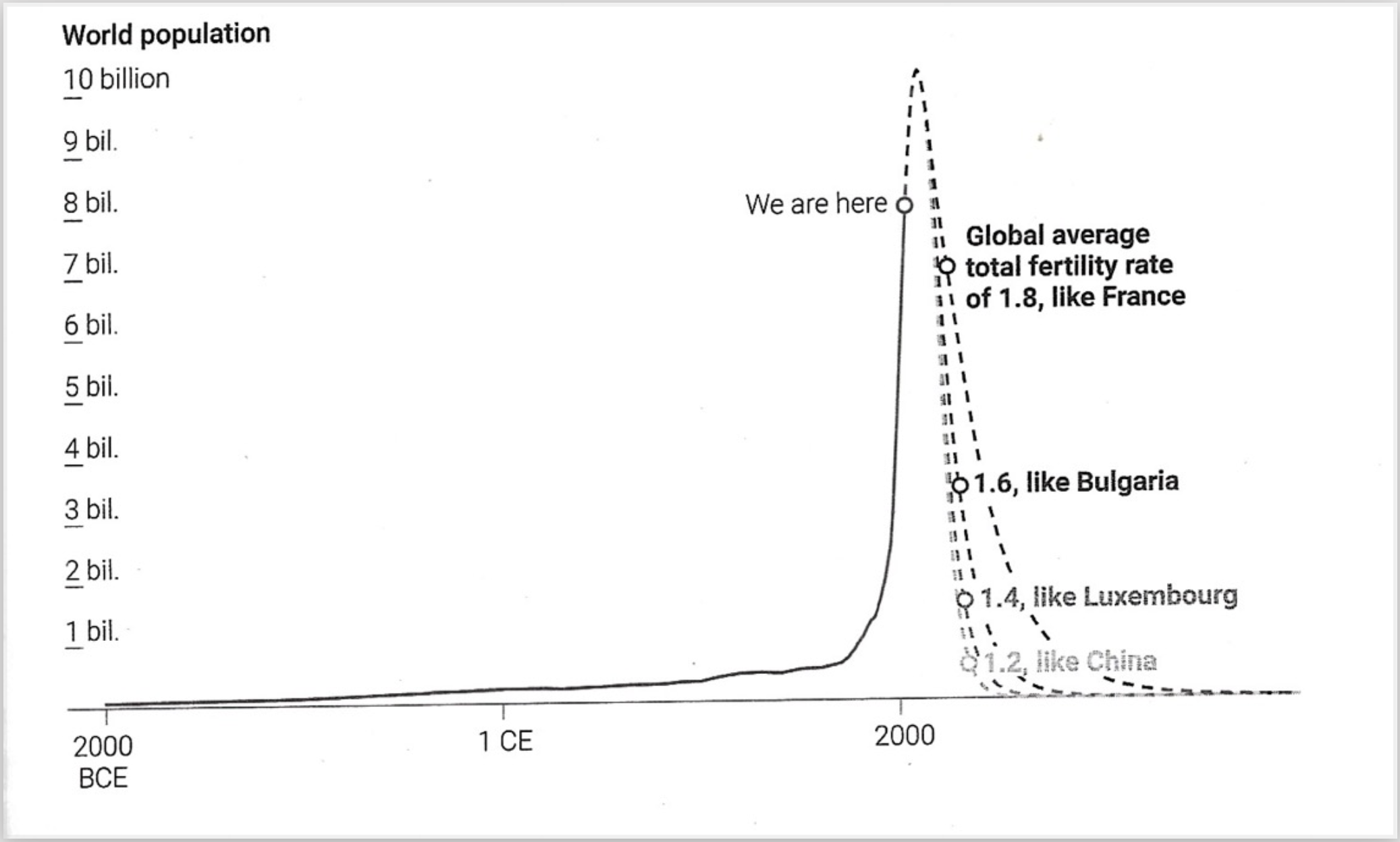
Demographically, humanity has been on a wild ride over the last four hundred years: World population grew by an average of just 0.04% annually for about 10,000 years to 1700. Then it ballooned; from 600 million in 1700 it reached 1 billion around 1800, then 3 billion in 1960, and 8 billion in 2023.3
However, a momentous new phase of history is coming into view. The whole world has experienced or is going through a demographic transition from high fertility and mortality to low fertility and mortality. Increasing numbers of countries are experiencing a second transition to ultra-low levels of fertility, well below that required to maintain a stable population.
The total number of people on the planet is projected to peak this century, and thereafter to decline for the first time since the Black Death plague of the 1300s. In its latest biannual World Population Prospects report, the United Nations projected a peak of about 10.3 billion in the mid-2080s, thereafter declining to about 10.2 billion by the end of the century.4
In association with but well before the global population peak, populations everywhere are aging. The global median age rose from 23 in 1990 to 31 in 2025. Countries where the demographic transition is further advanced are much grayer; median age in Japan is 49. Across the advanced countries that are members of the Organisation for Economic Cooperation and Development (OECD), the old-age dependency ratio, measured as people 65+ per 100 working-age people, rose from 19% in 1980 to 31% in 2023 and is projected to reach about 52% by 2060.5
Increasing life expectancy is a key driver of this trend. The U.N. estimates that global median life expectancy rose from about 46 in 1950 to 73 in 2019, and projects a further increase to 77 by 2054.
But though increasing life expectancy creates a "demographic push" towards continued increases in total population, this can only last so long if fertility, representing the supply of new people to replace the old, falls below replacement for too long. And this is now the reality for many countries, and the almost certain near future for many more.
The U.N. takes an average of 2.1 babies per woman to be 'replacement fertility', equating to two children surviving to adulthood. Other factors, such as migration, being equal, any higher rate means long-term population growth; anything lower means long-term decline.
The global fertility rate has been falling for decades. The U.N. estimates that by 2024 total fertility rate, or TFR, reached 2.2 births per woman, down from 3.3 in 1990, itself down from around 5 in the 1960s. It is projecting further falls, to the replacement level of 2.1 in 2050 and then 1.8 births per woman in 2100.6 Independent research published in 2024 projected a steeper decline in TFR still. Natalia Bhattacharjee and colleagues forecast that global TFR projected will fall to 1.83 in 2050, and then to 1.59 in 2100, leaving only 49 countries with above replacement fertility in 2050 and just six in 2100.7
Global and regional TFR projected to 2100

As evidence of widespread declines in fertility has grown, so the U.N. has revised down its forecast for the global peak population: its latest projection is 700 million lower than a decade ago. "The demographic landscape has evolved greatly in recent years," Li Junhua, UN Under-Secretary-General for Economic and Social Affairs commented in 2024. "In some countries, the birth rate is now even lower than previously anticipated, and we are also seeing slightly faster declines in some high-fertility regions."
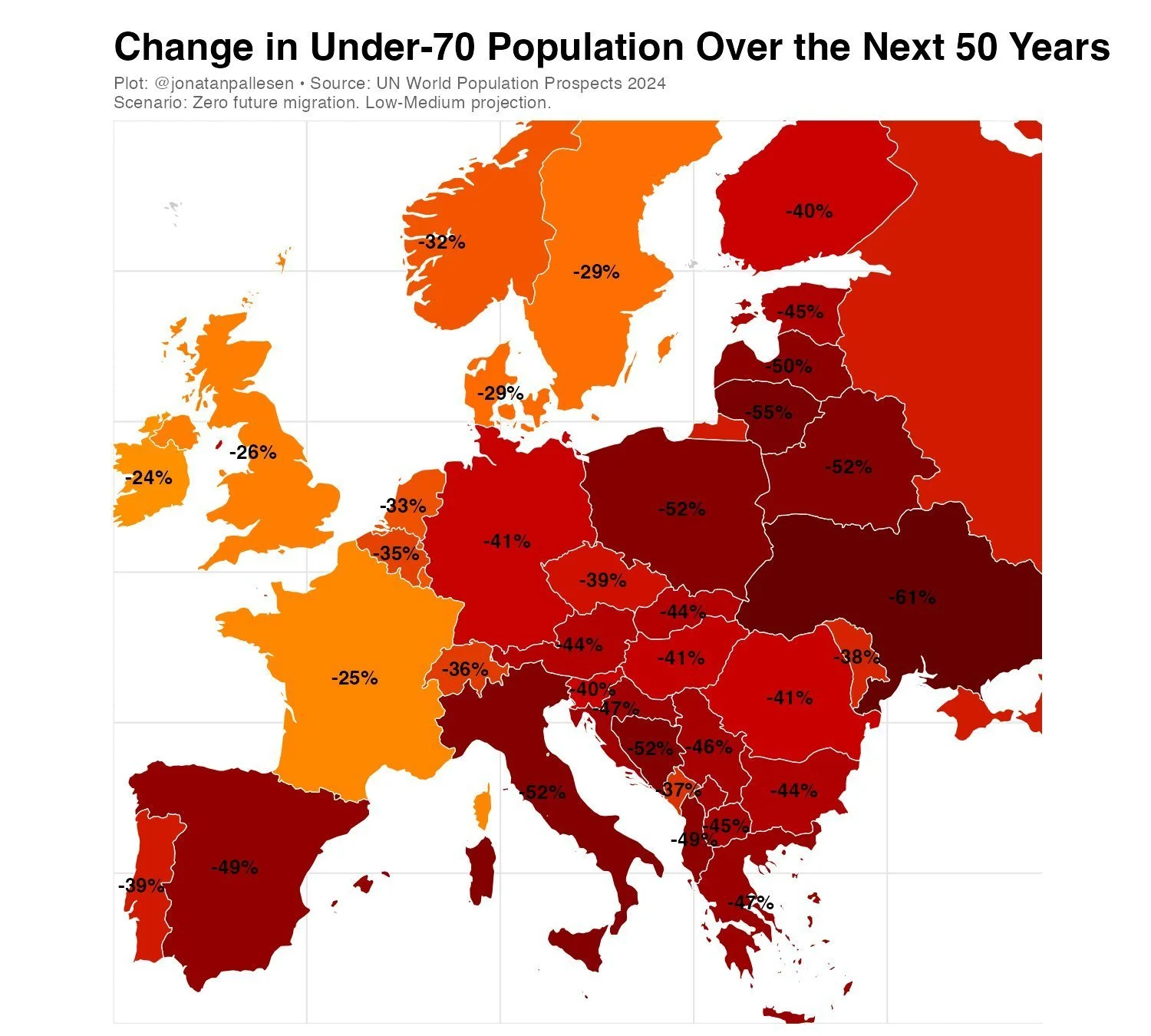
According to the U.N.'s World Population Prospects publication, the number of people has already peaked in 63 countries and areas, including China, Germany, Japan and the Russian Federation. Population is projected to peak by 2054 in another 48 countries, including Brazil, Iran, Turkey and Viet Nam. Without inward migration or a major recovery in fertility rates, the whole of Europe will see very substantial declines in the number of under 70-year-olds over the next 50 years.
In the remaining 126 countries, including India, Indonesia, Nigeria, Pakistan and the United States of America, population is expected to peak in the second half of the century or later. In the vanguard of this shift, a number of countries now have ultra-low fertility approaching or even below 1 child per woman. South Korea is the most cited example, having reached a TFR as low as 0.7 by some estimates. But an increasing number of others are heading this way, including the world's formerly most populous country, China, where TFR may well now be below 1.
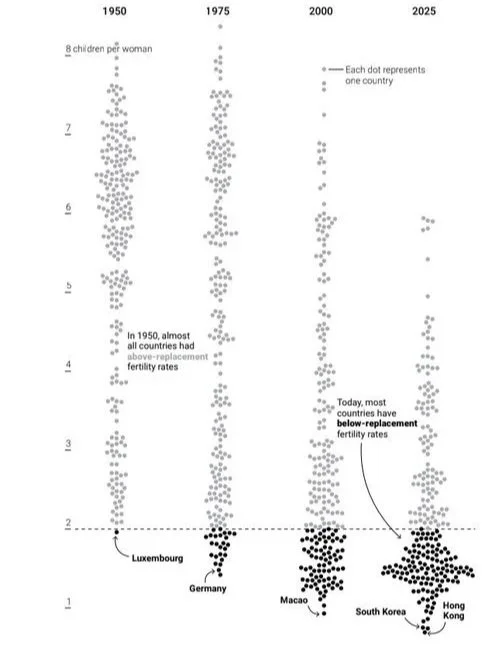
Dropping below two, country by country
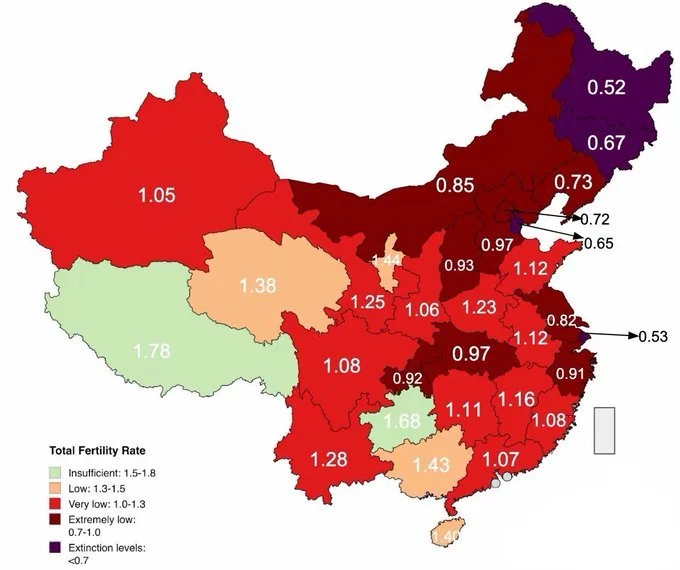
An important feature in countries with very low fertility is that there tend to be significant regional differences, so that one or a few large urban areas, known as "sponge cities" maintain their size or even keep growing, amidst progressive depopulation in rural areas. An increasing share of Japan's and South Korea's populations, for example, are concentrated in Tokyo and Seoul, respectively. The TFR map of China shows that some regions now have "extinction-level" TFR.
Should anything be done?
Any serious discussion of fertility decline eventually runs into the question of causes. Here, the literature is vast, contested, and deeply multi-factorial. Proposed explanations range from economic insecurity, income inequality and housing costs, to changing family norms, delayed partnership formation, education and labour-market structures, urbanisation, technological change, and shifts in expectations around work, autonomy, and parenthood. These dynamics interact differently across societies and over time, and no single theory commands consensus. A full treatment of causes is outside the scope of this paper, and would require a separate paper, or several. For present purposes, it is sufficient to note that fertility decline is not obviously the product of a single policy failure or cultural choice, but of overlapping structural forces.
How seriously should the world take declining fertility? For now the mainstream view is that, while it will certainly be impactful and could pose significant challenges, it should not be viewed as a crisis. The few world governments that have publicly identified low fertility as a national challenge and instituted pro-natal policies have faced suspicion and allegations of ethnic nationalism, even in respected media.8
This conventional wisdom was summarised well by The Economist magazine in September 2025 when it reviewed fertility trends and concluded "there is reason to pay attention, but not to panic."9 It acknowledged that population aging and shrinking could be disruptive, but concluded that predictions of demographic disaster this century "[do not] seem plausible".
The international community as a whole has not given a high priority to the issue of declining fertility. It is not among the 17 global Sustainable Development Goals and 169 underpinning targets agreed in 2015.10 Nor is it mentioned in the UN's latest annual report on the goals.11 The U.N. General Assembly has never devoted a Resolution to declining fertility.
This relatively low status within the U.N. system is also reflected in staffing and finance. The main focus of the U.N. Population Fund (UNFPA) and its $1.5 billion annual budget is on sexual and reproductive health plus family planning. The Population Division of the Department of Economic and Social Affairs (DESA), which tracks global population trends, has only 46 staff, of which only 29 are demographers. Moreover, DESA appears still to be animated at least as much by out-dated fears of over-population as of decline. Launching its latest biannual population review in 2024, Li Junhua, U.N. Under-Secretary-General for Economic and Social Affairs welcomed a forecasted end to world population growth and warned that political attention should remain on curbing per capita environmental impacts. "The earlier and lower peak is a hopeful sign. This could mean reduced environmental pressures from human impacts due to lower aggregate consumption." Only in June 2025 did UNFPA publish its first large international survey focusing on low rather than high fertility issues. This noted an "unprecedented decline" in fertility rates, but concluded that the "real fertility crisis" is not falling numbers themselves, but a lack of individual agency over reproductive choices.12
Official voices frequently warn against discussing declining fertility as a crisis, and even against governments encouraging higher birth rates. Launching the UNFPA's 2025 survey of low fertility the agency's head Natalia Kanem, said: "Right now, what we're seeing is a lot of rhetoric of catastrophe … which leads to this kind of exaggerated response, and sometimes a manipulative response."13
Many independent experts concur. In response to the UNFPA report, Professor Stuart Gietel-Basten, demographer at the Hong Kong University of Science and Technology, said: "We want to try as far as possible to avoid those countries enacting any kind of panicky policies. We are seeing low fertility, population ageing, population stagnation used as an excuse to implement nationalist, anti-migrant policies and gender conservative policies."
Official bodies sometimes also warn that efforts to raise fertility are futile. In a 2024 review of social trends with a focus on fertility, the OECD explored pro-natal policies, concluding that: "because of changes in preferences regarding children, it is unlikely that such policies will enable countries to approach replacement fertility rates again."14 This is the opposite of the official approach to climate change, based on prioritizing mitigation.
One frequently deployed argument for a strategy of "watchful waiting" rather than intervention to counter declining fertility is that an "emptying planet", while conceivable, is too far into the future to worry about now. In its recent review, The Economist concluded that "2100 is so far away that forecasts beyond it seem pointless." And indeed, the U.N.'s latest official forecast points to a less than 1% fall in human population from its peak to the end of the century, which hardly adds up to a population crash.
Another is that, as expressed by the head of UNFPA quoted above, a reduction in world population should be welcomed as it will alleviate environmental pressures and bring human impacts back within "planetary boundaries".
A third argument is that declining fertility is a rich world problem, not a global one. The implication, sometimes made explicit, is that this is an issue of "white nationalism"15. Fourth, tackling low fertility is seen as conflicting with goals of female emancipation, autonomy and empowerment. In today's world, any possible connection of an issue with racism or sexism means that mainstream bodies will find it very difficult to engage with.
Finally, the argument is made that any declines in the working-age population, or finally in total population, can be compensated through inward migration, ensuring provision of public services and continued economic growth.16 This framing treats migration as a neutral demographic valve, but it obscures a critical asymmetry: Migration that stabilizes rich, aging societies often does so by extracting scarce human capital from poorer ones. For countries already facing low or falling fertility, the loss of their most educated, productive, and internationally mobile citizens can accelerate fiscal stress, weaken state capacity, and hollow out future growth. What appears as a solution at the destination may therefore function as a compounding destabilizer at the origin. In this sense, large-scale reliance on skilled inward migration risks shifting the demographic burden downward rather than resolving it, substituting global redistribution of talent for genuine demographic sustainability.
The case for action now
But evidence is mounting against the comforting view that declining fertility is not a major challenge facing humanity, or that it should not or cannot be tackled directly; that we should simply adapt.
The idea that below replacement fertility is a Western disease is simplistic. These countries experienced some of the earliest sustained falls in fertility, and therefore experiencing the greatest population aging, and in some cases shrinkage, first. But many non-Western countries have experienced the same or even greater declines later, often in a more concentrated way. Sub-Saharan Africa is the only world region that is still well above replacement fertility, and even here the rate is dropping too.
In sum, fertility declines, increasingly to levels well below replacement, is a world-wide trend, affecting rich countries and poor ones, secular and religious, Christian and Muslim, countries with easy access to birth control and countries without, countries with gender parity and those without, countries with generous state support for families and many without.
As noted above, it can take decades for persistent below-replacement fertility to feed through to a reduction in population size. However, like an oil tanker or glacier, its effects are inexorable and, so far, there is no sign that any of the efforts made by a few countries to lift fertility rates is capable of making more than a marginal difference – for example, a laudatory review of French pro-natal policies estimated that they have perhaps increased total fertility rates in France by 0.1 to 0.2.17
Demographers Dean Spears and Michael Geruso emphasise an additional important point. Changing fertility rates eventually drive population numbers up or down in exponential rather than linear fashion. Therefore, if fertility remains even marginally, but persistently, below replacement across most of the world then this points to a truly enormous reduction in global population over the next few hundred years.
The long-termist philosophical tradition may argue that the deeper concern here is ethical rather than institutional: That a world with far fewer future people represents a loss of potential lives, discoveries, and human experiences. That long-horizon argument is coherent, and increasingly debated in philosophical circles; yet this article does not depend on it. Even setting aside questions about the moral weight of unborn generations, the nearer-term implications for democratic capacity, institutional stability, and intergenerational balance are sufficient to warrant serious attention now.
A recent academic paper has also demonstrated that, contrary to a widely held belief, global depopulation rather than stabilization will make very little difference to the aggregate level of greenhouse gas emissions and only a tenth of a degree difference in atmospheric temperatures, due to projected declines in per capita emissions.18
It is sometimes argued that a smaller human population would ease pressure not only on the climate but on ecosystems more broadly - land use, biodiversity loss, freshwater depletion, and other planetary boundaries. That claim deserves serious consideration; and it is not the position of this paper to discuss. But demographic contraction driven by persistently ultra-low fertility is not the same as an orderly, intentional stabilization at a sustainable level. An unmanaged, ageing-led decline risks institutional fragility long before it delivers ecological equilibrium, and there is little evidence that shrinking populations automatically translate into proportionate reductions in aggregate environmental impact without parallel structural change in consumption and production.
The authors calculate these small differences in long-run emissions and temperatures by comparing scenarios with a 17% difference in global population by 2100 and a 90% difference by 2200. The key to combating climate change, they conclude, is early reductions in per capita emissions, not long-run depopulation.
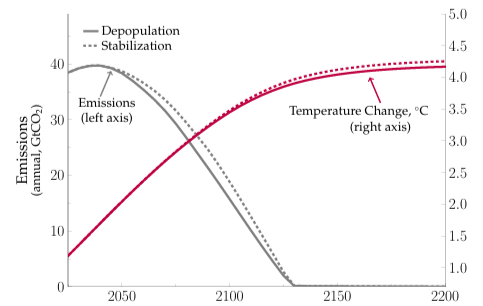
Long-run warming is similar between population scenarios
Meanwhile, economists are increasingly clear on what aging and then declining populations will mean for global welfare, economic growth, and innovation.
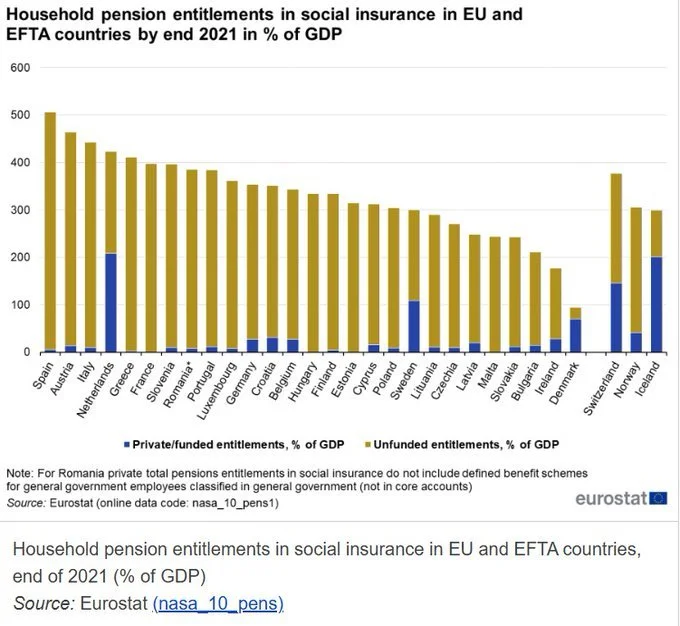
When each cohort of young people is smaller than the one before, the working-age population eventually stops growing and begins to shrink even while increased life expectancy means that the number of older people keeps growing. As a result the old-age dependency ratio, measured as the number of people 65+ per 100 workers, can rise sharply, putting huge pressure on public finances. Across the OECD countries, the number of people aged 65+ per 100 people aged 20-64 is forecast to increase from 22 in 2000 to 52 in 2050.19 Countries with a high old-age dependency ratio will have higher health and social care costs and high levels of committed old-age pensions with a smaller and even shrinking tax base to fund them. The unfunded pension liabilities in European countries are already extremely alarming; many other countries are heading in the same direction.
Across advanced economies where fertility has fallen below replacement for decades, the demographic inversion is already measurable in hard economic outcomes. The Organisation for Economic Co-operation and Development projects that by 2060 the ratio of people aged 65+ to those aged 20–64 in OECD countries will rise from ~31 % in 2023 to ~52 %, with countries such as Italy, Japan, and South Korea exceeding 75 % dependency ratios - meaning fewer than four working-age adults per person over 65. In these same countries, forecasts show an 8 % decline in the working-age population and a substantial slowdown in annual GDP per capita growth from pre-2020 levels of ~1 % to around 0.6 % or less without structural change. 20
This is not an uncritical argument for GDP as a be-all, end-all measure for economic health of a country; but the fiscal pressures of an inverted population pyramid are inescapable: Pensions, healthcare, and social support outlays rise while the shrinking tax base struggles to fund them. This demographic squeeze has already prompted policymakers in several countries to contemplate raising retirement ages and cutting benefits to avoid unsustainable public debts.21
Simply put, these are structural economic factors that strain the social contract of citizens; study after study shows that poor economic prospects and high societal costs contribute to social unrest. Increasingly fewer younger citizens forced to work years or decades longer with lower reward to support an increasingly larger elderly cohort is a dangerous scenario for the stability of our democracies. A growing literature on ageing societies finds that as populations age and public resources skew toward older cohorts - via pensions, healthcare, and social security - intergenerational tensions rise and social cohesion weakens. Younger cohorts may feel disproportionately burdened by taxes and rising public debt, and older electorates are empirically linked to policy choices that favour current retirees over long-term investment in the young, which can aggravate intergenerational conflict and resentment. Cross-national analyses show that older electorates are associated with higher budget deficits and debt burdens shouldered by future generations, and that demographic ageing can contribute to age-based political polarization and distributive conflict between age groups.22
For example, studies document that as the share of older voters increases, support for redistributive policies that prioritise pensions and health over education and infrastructure grows, producing structural incentives that systematically shift costs onto younger generations. This is one of the mechanisms by which demographic imbalance contributes to social strain, with implications for political stability and the perceived legitimacy of democratic institutions.
Many economists think that an aging or shrinking workforce will also reduce productivity growth, through mechanisms like lower labour mobility and job-switching, slower adaptation to new technologies, and lower rates of entrepreneurship. Another likely trend, already seen in Europe and Japan, is lower domestic investment as demand for new housing and capital stock plateaus or falls.
An inverted population pyramid does something simpler and nastier than just “slow GDP growth”: It will drain institutional capacity. When cohorts shrink, you don’t just get fewer workers “in aggregate”; you get fewer people in the specific roles that keep a country runnable; carers, nurses, paramedics, teachers, junior civil servants, trades, local government staff. Demand for care rises sharply at the same time, so even a rich country can become a poor-service country: Queues will lengthen, local provision may collapse. Japan shows the social geometry of this: Falling births have driven accelerating school closures in depopulating regions, compounding the flight of young families and making some communities effectively non-viable. Reuters23 documented how closures have picked up pace as births fell faster than expected, with rural areas hit hardest. The downstream effect is not just a hit to GDP; it is the thinning of everyday civic life - fewer children, fewer institutions built around them, fewer reasons to stay, and then a feedback loop of exit.
The political economy may then tilt. In ageing democracies the median voter gets older, and budget choices follow; for example, with more protection for pensions and age-linked spending, less patience for long-horizon investments whose payoffs arrive after today’s electorate is gone. That is not a moral claim; it is a predictable incentive structure, and a real literature tracks it.24 One strand of empirical work explicitly tests how ageing shifts preferences away from education spending and toward pensions.
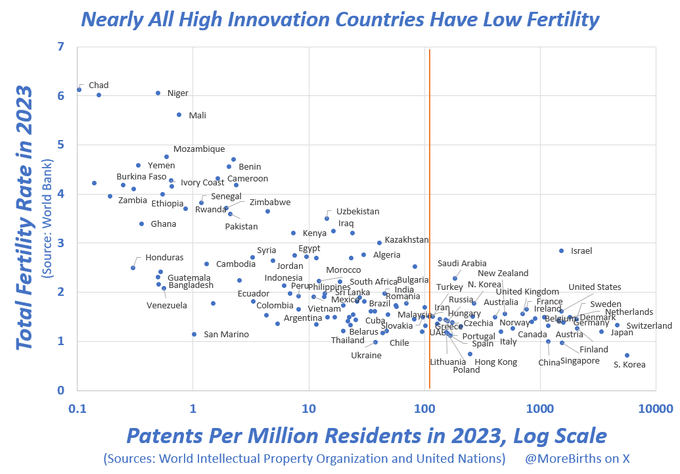
There are strong indications that aging and shrinking populations lead to a decline in rates of innovation, with knock-on reductions in long-term technological dynamism and improvements in living standards. 25 Smaller cohorts of young people simply means fewer potential high performers are born; societies dominated by the old may not encourage or reward innovation. An additional reason to worry about this is that the most historically innovative countries now have the lowest fertility, pointing to a potentially big reduction in the global rate of innovation. Innovation suffers through the same mechanism as service provision and the social contract: It is not a mystical product of “the economy”, it is a property of dense cohorts, churn, and risk-taking - all of which weaken when societies become older, more cautious, and more fiscally pre-committed. Meanwhile, the cultural cost is visible in the places that empty first: Villages and small towns lose the people needed to carry traditions forward. In Japan’s regions, festivals with centuries of history are being abandoned or radically simplified because there are not enough able-bodied participants to run them26. This is what demographic decline looks like on the ground: Not an abstract line on a UN chart, but the disappearance of institutions, rituals, and local continuity - the slow unmaking of social fabric.
While some industrialized countries may attempt to keep up innovation rates and economic growth by importing skilled labour, the OECD warns that this is not a permanent solution because “it would require an ever-increasing net migration rate across cohorts”.27 Meanwhile, low-fertility developing countries faced with the prospect of “growing old before they become rich” could end up the losers. Emigration of skilled labour can have positive as well as negative impacts on developing countries. However, one survey found “many more losers than winners”, caused by impacts on labor force skill structures, labor shortages and fiscal policy effects.28
The International Labor Organization was already expressing concern about this 25 years ago, noting that a few developing countries were losing up to 30 per cent of their highly educated citizens.29 These losses will become increasingly unaffordable for low and middle-income countries that are increasingly failing to replenish their own talent pools.
Then there are national security implications, arising in particular where there is differential population ageing or shrinkage between countries with a history of hostility. For example, the size of South Korea’s armed forces fell by 20% over the last six years, largely due to a sharp drop in the population of males of enlistment age for mandatory service.30 The number of 20-year-old men - the backbone of its conscription system - has dropped by roughly a third over the past decade. Between 2019 and 2025 the size of the South Korean armed forces fell by around 20%, to roughly 450,000 personnel, largely because there simply were not enough enlistment-age males to sustain prior force levels. Seoul has had to shorten service, rely more heavily on technology, and debate structural military reform - all under the shadow of an unchanged northern adversary. This is what demographic imbalance looks like when translated into hard power: Fewer troops and thus tighter readiness margins, and strategic options constrained not by doctrine but by birth statistics. Elsewhere, depopulation of Russia’s Far East is changing the power dynamics of its relationship with China, even though in some decades the latter could be facing similar problems. Likewise Europe and Russia are playing a long-term game of chicken of who can run out of fighting age men first. Disorienting and potentially dangerous differentials like this are beginning to appear all over the world.
To state clearly: The alarm is not that headline growth rates may ease; growth, in itself, is not sacred. The concern is structural for the stability of our democracies. When the base of the population pyramid narrows, the intergenerational bargain shifts. Systems built on the assumption of broad working cohorts supporting smaller retired ones come under sustained strain. Budgets become increasingly pre-committed to age-related spending, narrowing space for education, infrastructure, and renewal. Peripheral communities lose institutions as younger families concentrate elsewhere. Innovation thins as the density of younger, risk-taking cohorts declines. Military and civic capacity draw from a shallower pool. Opportunity becomes more tightly rationed, and politics more distributive.
An inverted pyramid is not likely to be a smaller version of a healthy society; it is a different configuration of power, risk, and possibility. That is the instability at issue.
It's worse than we think
For many countries these kinds of social and economic problems are still quite far into the future, according to official projections for fertility and population. However, there are worrying indications that the U.N. may be significantly underplaying the problem, through an abundance of caution or an unwillingness to express concern.
At an academic talk in 2023, economist Professor Jesus Fernandez-Villaverde cited a list of problems with the U.N.'s data that suggest more countries are likely to experience difficulties relating to low fertility sooner than according to official forecasts:31
Whereas the U.N. and standard demographic estimate of replacement fertility is 2.1, the real level needed for replacement is higher than that in most poorer countries, due to higher young female mortality and populations skewed male due to sex-selective abortions and infanticide. For example, relative to a ratio of 105 males to 100 females at birth in European countries, in both South Korea and China the ratio is 115 to 100.
Professor Fernandez-Villaverde estimates the real replacement fertility across developing countries to be 2.3 rather than 2.1. This may seem like a small increase, but a 0.2 difference in TFR is actually very significant.
For the world as a whole, Fernandez-Villaverde estimates the true replacement fertility rate is 2.21. He further calculates that actual global TFR was 2.17 in 2024 - so already below replacement. He forecasts that global population could well peak by 2055 - only 30 years from now and 30 years earlier than the latest UN forecast.
Second, through adjustments intended to make up for poor data collection, Professor Fernandez-Villaverde claims that the U.N. is very likely over-estimating both current population and numbers of births in many countries. He reports that a recent national census put Brazil's population at 203 million, 4% less than according to the U.N., and one in Paraguay put its population at 6.1 million, 12% lower.
Certainly, raw data on births and TFR published by many countries do paint a worse picture than does the U.N. According to figures tracked by Birthguage, a widely followed account on X, TFR has fallen in the last ten years by 39% in Egypt, 40% in Tunisia, 42% in Bolivia and China, 43% in Ukraine, 44% in Thailand and the Philippines, 49% in Argentina, and 57% in Macao.32 Taking just one of these countries, fertility in the Philippines fell from nearly 3 to as low as 1.6, well below replacement, in just the last decade.33
Third, Fernandez-Villaverde points out that many U.N. forecasts for future trends in country fertility look highly unrealistic. The U.N. projects that fertility will stabilise in countries with medium but falling fertility, while in countries with very low fertility, it will rebound to higher levels again. This is illustrated by South Korea, where TFR fell from above 1.2 to nearly 0.7 over the last ten years, but the U.N. forecasts a recovery back to 1.3 by 2100.

The world needs to wake up
International bodies and national governments need to take the problem of declining fertility more seriously, not in twenty or fifty years, but right now. Demographic change happens over decades not years. However, the demographic dynamics are also remorseless - a below replacement fertility rate today inexorably produces a smaller cohort of new mothers in 20-30 years' time, at which point only a return to an unrealistically high fertility rate on the scale seen in past generations would suffice to even stabilise, let alone regrow a country's population.
As demonstrated above, contrary to most expectations, fertility rates are in decline almost everywhere, with no clear floor above a level pointing to drastic population shrinkage within current lifetimes.
And this is the reason why even countries just now approaching or falling below replacement fertility, which may not even have entered significant population ageing, let alone shrinkage, need to pay attention now. To give one example, France has a decades-old state commitment to pronatalism, which President Emmanuel Macron's strengthened further in 2024 with a pledge of "demographic rearmament".34 The country has notably higher fertility than those surrounding it, but still its "edge" is only to have achieved a TFR of 1.6, a gain of only 0.2 and still 33% below a long-term stable population.
In addition, as a massively complex social and cultural phenomenon, fertility appears not to be amenable to short-term fixes, and evidence to date generally suggests that offering people financial incentives to have babies is ineffective, at least at anything like affordable rates. Hungary is often cited in this regard. Under Prime Minister Viktor Orban it has introduced a range of financial support for parenthood, channelling up to 6% of GDP on family-related spending. In 2023 the government claimed success for its policies, pointing to an increase in TFR from 1.25 in 2010 to 1.59 in 2021. However, researchers have since pointed out that underlying fertility did not increase at all over this period, with the rise in TFR being in fact an artifact caused by women having babies earlier rather than having more.35
What is required, therefore, is for the world to actively engage with declining fertility, to launch a deep and thoroughgoing dialogue on its causes, consequences and potential counter-measures, and for countries most at risk to begin implementing measures immediately, as consultancy McKinsey put it in a 2025 report, "raise fertility rates to avert depopulation - a societal shift without precedent in modern history".36 To fail to do so risks introducing unsustainable levels of instability into global systems.
Recommendations
At UN level:
1) Achieving population stability should become a UN sustainable development goal. As Spears and Geruso emphasise in After the Spike, this doesn't mean stability at current levels, but rather a commitment to stability at some level, in other words a commitment to avoiding permanent contraction.
2) From its next biannual assessment in 2026, UNFPA must reassess its estimates of both current population and population projections, integrating the insights of a multidisciplinary scientific community and incorporating more realistic expected scenarios of fertility rates.
3) The UN system should offer concrete assistance to countries with ultra-low birth-rates, at least creating a standing secretariat to share data, information and policy ideas, and bringing together governments in annual Fertility Tracking meetings, including attendance by senior government representatives.
4) The UN should launch a reassessment of international migration, aimed at raising awareness of the long-term challenge facing poorer countries facing population and economic decline, who cannot afford to lose their relatively few highly educated and most innovative citizens to rich countries.
At national level:
5) Governments of countries where fertility is falling but still close to replacement should launch national conversations about fertility trends and their implications for society and the economy, supported by expert findings from commissions of inquiry. These processes should inform what low fertility will mean for future generations, socially, fiscally and economically.
6) Additionally to the above, countries with significantly below-replacement fertility - say below 1.8 - need to consider practical policies to support higher birth rates and to ensure sustainability of public finances as populations age. These will depend widely on specific national and cultural factors to be mapped by nations through research. Where national politics make it difficult to focus explicitly on fertility, a range of no-regrets policies that will benefit society even if they do not raise birth rates, should be tried, such as increasing availability and affordability of housing in countries where that is a problem.
7) Additionally to the above, countries with ultra-low birth rates - say below 1.4 - need to make higher fertility into a national priority, driven from the top of government, and with significant fiscal backing, to the extent of several per cent of national GDP. As above, specific policies will depend on many local choices, and should start with identifying barriers to increasing fertility rate and no-regrets policies. But these will probably have to include specific support for babies, at least for families with third or higher ranked children, as well as measures to encourage, or at least to remove discouragement, of early family formation.
Overall, it is important to highlight that falling fertility rate is a complex problem with multiple root causes and no single solution will effectively address it. Nations will need to identify their specific drivers of low fertility and develop evidence-based policies with a holistic perspective that targets those drivers simultaneously.
Image sources
Figure 1: Global and regional TFR projected to 2100. Source: Bhattacharjee, N. et al. (2024). The Lancet. Source: Available here
Figure 2: European population projections. Source: UN World Population Prospects 2024. Available here
Figure 3: Multi-country change in fertility rate. Source: Our World in Data (2025). Available here
Figure 4: TFR map of China. Source: Arouet, Michael. (2025). Available here
Figure 5: Long-run global population trend. Source: Dean Spears & Michael Geruso, After the Spike: The Risks of Global Depopulation and the Case for People (2025).
Figure 6: Emissions vs temperatures. Source: Budolfson, M. et al., NBER (2025). Available here
Figure 7: European household pension entitlements. Source: Eurostat via Daniel Lacalle (2025). Available here
Figure 8: Patent intensity vs fertility. Source: Hess, Daniel, @MoreBirths (2023). Available here
Figure 9: South Korean total fertility rate vs projections. Source: Fernandez-Villaverde, Jesus. (2025). Available here
Notes and References
1 Raising ambition and accelerating delivery of climate finance: Third report of the Independent High-Level Expert Group on Climate Finance (2004) Available here ↑
2 Shaw, Stephen J. (2025) The Inverted World Report: The Crisis to End all Crises Available here ↑
3 Population Growth Key Insights, Our World in Data Available here ↑
4 World Population Prospects 2024, United Nations Available here ↑
5 OECD Employment Outlook 2025, OCED (2025) Available here ↑
6 World Fertility 2024, United Nations Available here ↑
7 Bhattacharjee, N. et al. (2024), "Global fertility in 204 countries and territories, 1950–2021, with forecasts to 2100: a comprehensive demographic analysis for the Global Burden of Disease Study 2021", The Lancet, Available here ↑
8 Macron Wants More French Babies, But His Meddling in Fertility Isn't the Answer, The Guardian, 9 Feb 2024. Available here ↑
9 Don't panic about the global fertility crash, The Economist, September 13th 2025 Available here ↑
10 United Nations Sustainable Development Goals Available here ↑
11 The Sustainable Development Goals Report 2025, United Nations Available here ↑
12 The Real Fertility Crisis: The Pursuit of Reproductive Agency in a Changing World, UNFPA (2025) Available here ↑
13 World fertility rates in 'unprecedented decline', UN says, BBC (2025) Available here ↑
14 Society at a Glance 2024: OECD Social Indicators, OECD (2024). Available here ↑
15 King, Leslie, "Demographic Trends, Pronatalism, and Nationalist Ideologies in the Late Twentieth Century" (2002) Available here ↑
16 The facts are stark: Europe must open the door to migrants, or face its own extinction Available here ↑
17 Does Pro-Natal Policy Really Work? It Did in France. 6 February 2025. Available here ↑
18 Is less really more? Comparing the climate and productivity impacts of a shrinking population. Budolfson, M, et al. NBER (2025) Available here ↑
19 Pensions at a Glance 2025: OECD and G20 Indicators, OECD, January 2026. Available here ↑
20 Without Remedy, Countries With Aging Populations Are Set for Weaker Income Growth, Says OECD Available here ↑
21 The Impact of OECD Population Aging on Productivity and Economic Growth Available here ↑
22 Family Matters: How Concerns about the Financial Wellbeing of Young Relatives Shape the Political Preferences of Older Adults Available here ↑
23 Last students graduate: School closures spread in ageing Japan Available here ↑
24 Greying the Budget: Ageing and Preferences Over Public Policies Available here ↑
25 The Economic Case for Higher Birth Rates Is Bigger than You Think, Michael Geruso & Dean Spears. Substack (2025) Available here ↑
26 The End of Tradition? Adaptation and Abandonment of Festivals in Japan’s Rural Communities Available here ↑
27 Pensions at a Glance, OECD, op cit. Available here ↑
28 The brain drain from developing countries, F. Docquier, IZA World of Labor (2014) Available here ↑
29 Migration of highly skilled persons from developing countries: Impact and policy responses, International Labor Office (2001) Available here ↑
30 South Korea's military has shrunk by 20% in six years as male population drops, Reuters (2025). Available here ↑
31 The Demographic Future of Humanity: Facts & Consequences, Jesus Fernandez-Villaverde (2025) Available here ↑
32 @Ulmer62336950 on X.com using data from @Birthgauge (2025) Available here ↑
33 @AccurateCaption on X.com Available here ↑
34 'Demographic rearmament': Macron plans to reform parental leave and fight infertility, Solene Cordier, Le Monde (2024) Available here ↑
35 Evaluating pronatalist policies with TFR brings misleading conclusions: examples from Hungary, Wolfgang Lutz, Tomás Sobotka and Kryštof Zeman, N-IUSSP (2024). Available here ↑
36 Dependency and depopulation? Confronting the consequences of a new demographic reality, Anu Madgavkar et al, McKinsey Global Institute (2025). Available here ↑