
The Collapsing Credential: The AI Era Demands a New Model for Education
By Kareem Mathias, in collaboration with the Geopolitical Insight and Education Foundation
The “Signal” Is Failing
In January 2023, on his first full day in office, Pennsylvania Governor Josh Shapiro signed an executive order removing four-year degree requirements from 92 percent of state government jobs, roughly 65,000 positions. Less than a year later, over 60 percent of new employees who joined the Commonwealth were hired without a college degree (Commonwealth of Pennsylvania, 2024).
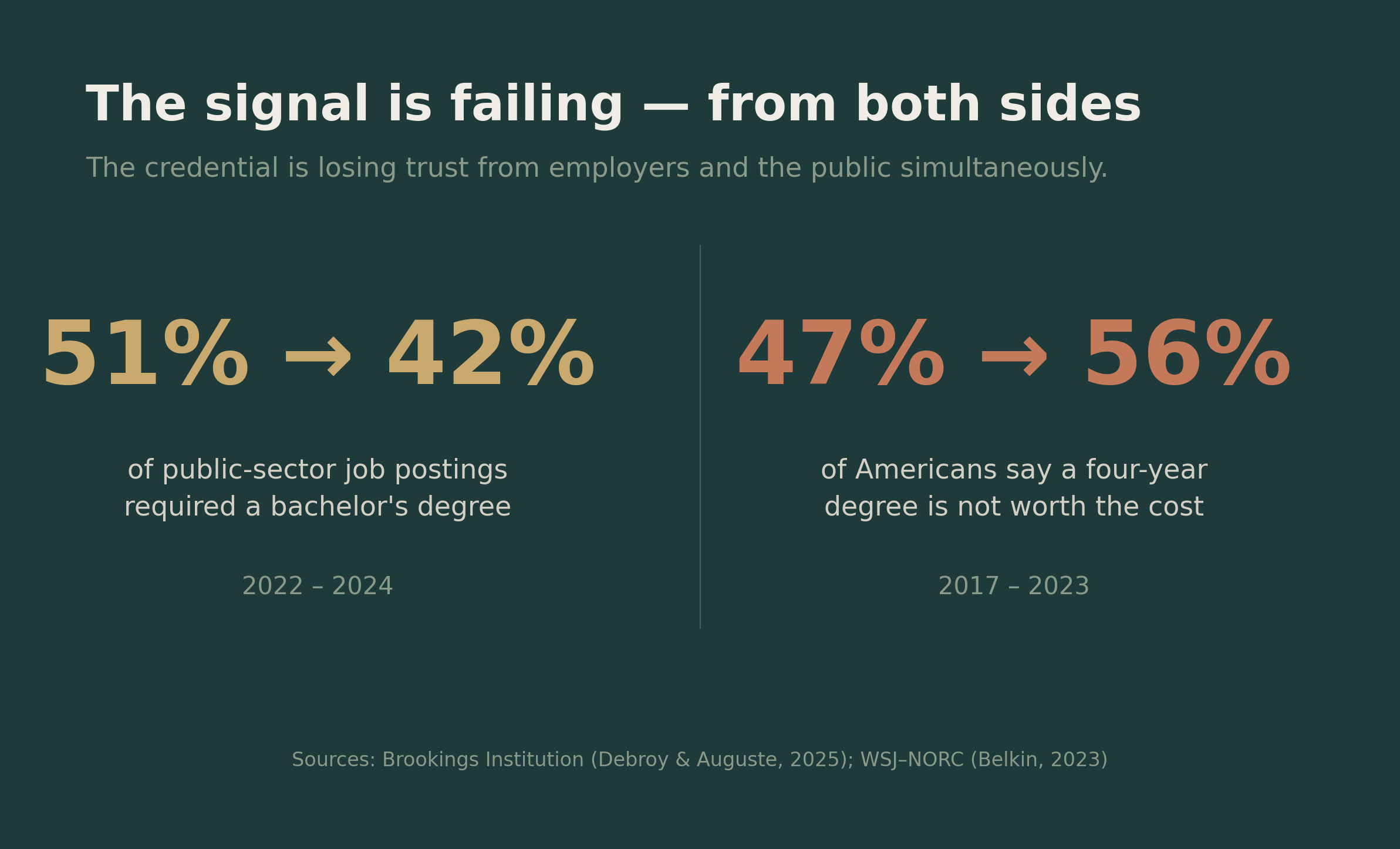
Pennsylvania is not an outlier. Twenty-five states have now taken steps to remove degree requirements from state government hiring including Maryland, Colorado, Utah, and Alaska through executive order or through legislation (Cooper, 2025; Cicero Institute, 2025). The reforms are producing measurable results: A Brookings Institution analysis found that the share of public-sector job postings requiring a bachelor's degree fell from 51 percent to just under 42 percent between 2022 and 2024 (Debroy & Auguste, 2025). At the federal level, a 2020 executive order directed agencies to prioritize skills-based assessments over educational credentials for federal hiring, a policy retained across administrations (The White House, 2020). In the private sector, IBM, Google, Accenture, Bank of America, and Walmart have all publicly reduced or eliminated degree requirements for significant portions of their workforce (Caminiti, 2022; Fuller & Raman, 2017; Burning Glass Institute, 2022).
These policy changes denote a larger structural shift: The four-year college degree, which has long been the dominant mechanism by which most Western countries sort human capability into economic opportunity, is fundamentally at risk of losing its status as a reliable signal of competence and skill.
The consequences extend well beyond labor markets. When the primary mechanism by which societies sort capability into opportunity loses public credibility, the effects compound through every institution that depends on legible, trusted processes - courts, legislatures, public administration, and the democratic social contract itself. Public sentiment tracks the same direction; for example, a Wall Street Journal–NORC survey found that 56 percent of Americans believe a four-year degree is not worth the cost, up from 47 percent in 2017 (Belkin, 2023). What happens to economic opportunity and democratic legitimacy when the primary trust infrastructure for individuals to pursue social mobility is in decline?
The implications for democratic legitimacy are quite direct. Citizens need not believe that opportunity is perfectly allocated - but they do need to believe that the systems allocating it are legible and broadly fair. When that belief erodes, the political consequences follow predictably.
Generative artificial intelligence tools affect the legitimacy of our social contract as regards higher education from two different angles acutely. AI not only introduces the opportunity for a new form of academic dishonesty where students can have their work completed easily, accurately, and with little thought; it also severs the link between credential completion and demonstrated competence in a way that prior disruptions had not. With AI tools readily available to complete any task, how can we be sure someone truly internalized all of the lessons that a college education is designed to provide? The response is not to abandon credentialing or to police AI use in classrooms, but to fundamentally shift what education credentials certify. This shift must move from knowledge retention to demonstrated capability. The future of education in the AI era is teaching people to think and create, then using the result as a certification of the knowledge they gained.
What’s in a Degree
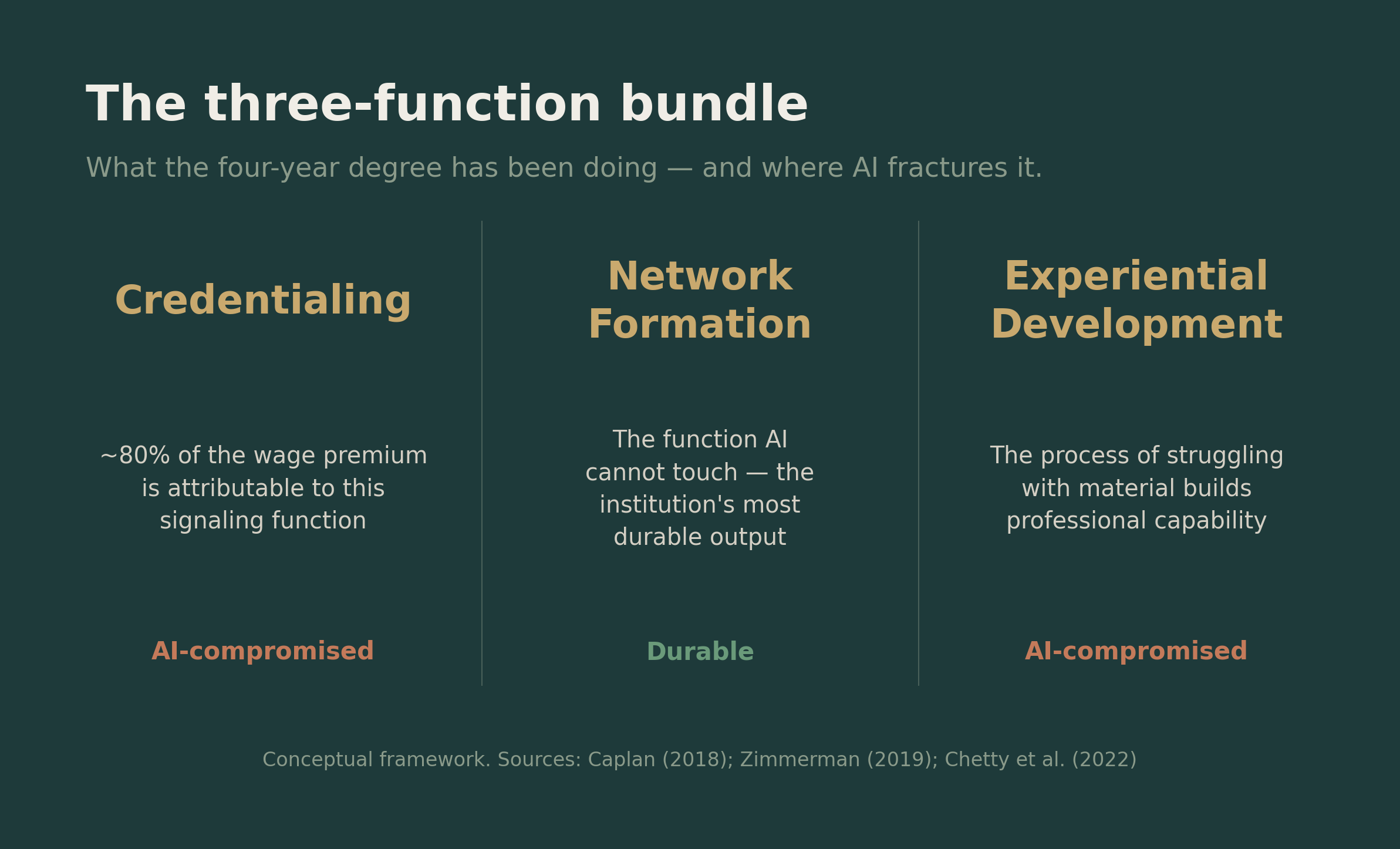
To understand what is failing, it helps to understand what the four-year degree has been doing in labor markets for the past century. The degree has performed three distinct functions, often conflated due to how interconnected they are:
The first is credentialing. It certifies to employers that a graduate possesses a baseline of knowledge and competence in a given field. The very definition of accrediting in a collegiate sense imbues this authority: “Accrediting - to recognize (an educational institution) as maintaining standards that qualify the graduates for admission to higher or more specialized institutions or for professional practice” (Merriam-Webster, n.d.).
Economist Bryan Caplan has argued, with substantial empirical support, that approximately 80 percent of the wage premium associated with higher education is attributable to this signaling function rather than to skills acquired during study (Caplan, 2018).
The second function is network formation. College exposes students to peers, mentors, alumni, and institutional affiliations that shape career trajectories. These networks are real and valuable. Most notably, they are not equally distributed. Elite institutions produce disproportionately powerful networks - graduates of elite colleges are dramatically overrepresented in top jobs and leadership positions (Zimmerman, 2019) - which is part of the reason institutional prestige persists even as the knowledge content of curricula converges.
The third function is experiential development. The process of completing a degree, managing deadlines, navigating complex material, collaborating with others, and producing work under constraint. This work builds capacities that are relevant to professional performance. The conventional wisdom of the "college builds character and maturity" argument rings true as the discipline required to complete a challenging curriculum does produce developmental outcomes.
These three functions of credentialing, network formation, and experience development have historically been bundled together in a single four-year package. The degree was a convenient, if imperfect, proxy for all three. Employers did not need to distinguish which function they were paying for, because the bundle held together: A person who completed the degree had, presumably, acquired some knowledge, built some network, and undergone some development. This bundling also performed a civic function; a broadly trusted credentialing system provides a common language between citizens and institutions - a shared basis on which competence can be asserted and contested. Previous GIE Foundation research by Professor Sam Illingworth focused on the human capacities most essential to democratic institutional function, that are precisely those most resistant to measurement and most vulnerable to systematic undervaluation (Iorio & Illingworth, 2026). The degree, for all its imperfections, was one of the few widely accepted mechanisms for making those capacities legible and transferable.
The Integrity Collapse
Generative AI has introduced a structural break in the credentialing function of the degree. This is not the familiar complaint about academic dishonesty; students have always found ways to cut corners. The difference is one of kind, not degree: for the first time, the marginal cost of producing competent-looking academic work without engaging with the underlying material has fallen to near zero.
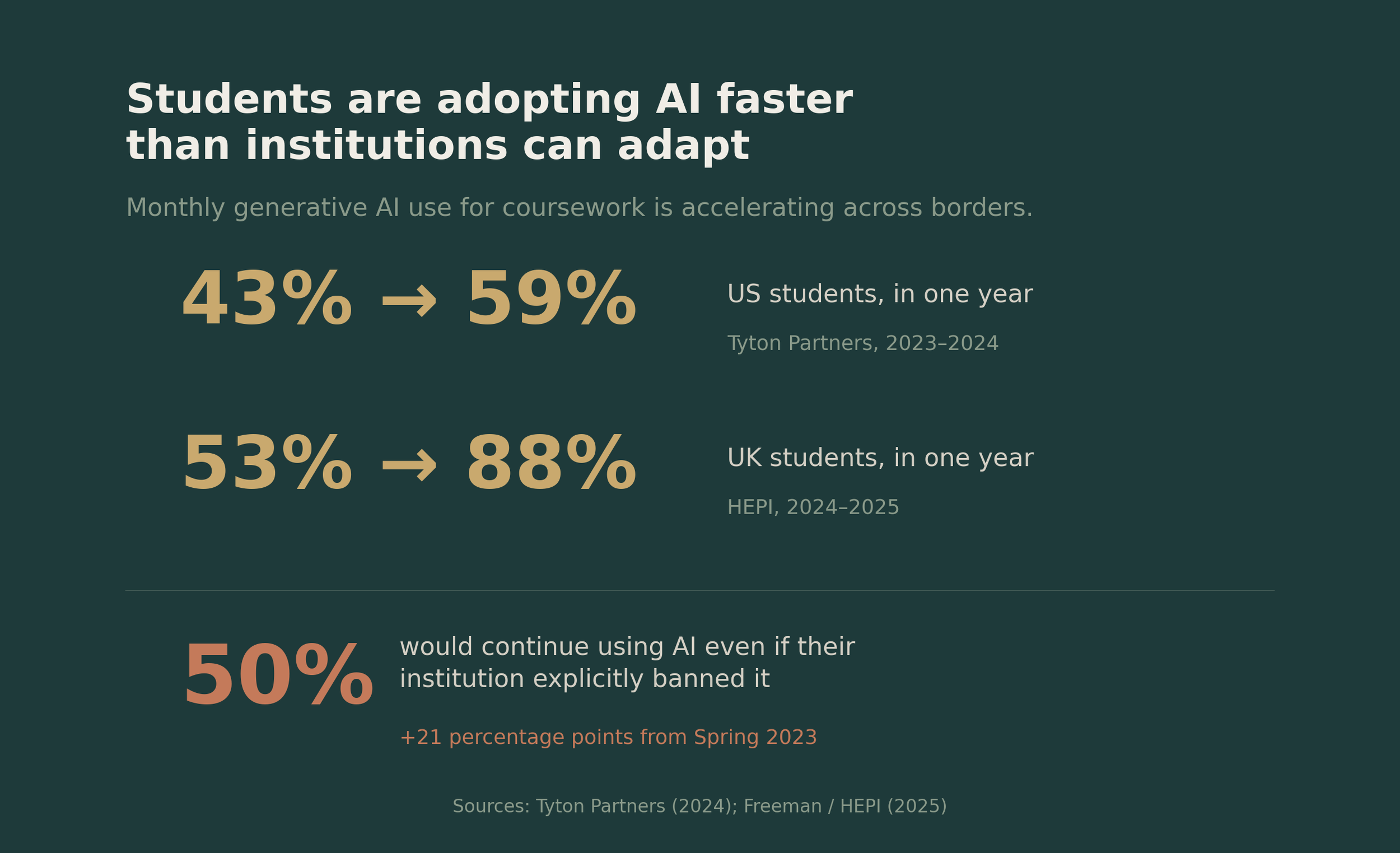
The data confirm rapid adoption. Tyton Partners' Time for Class 2024 survey of more than 3,000 higher education stakeholders found that 59 percent of students reported using generative AI tools for coursework at least monthly, up from 43 percent just one year earlier. More striking, 50 percent of students indicated they would continue using AI for schoolwork even if their institution or instructor explicitly banned it, a 21-percentage-point increase from spring 2023 (Tyton Partners, 2024). By 2025, the follow-up survey found that daily AI use among instructors correlated with reduced workload, while the monitoring burden on faculty continued to grow (Tyton Partners & D2L, 2025). The pattern is not confined to the United States: the UK's Higher Education Policy Institute found generative AI use among students has jumped from 53% last year to 88% (Freeman, 2025). Students are adopting AI faster than institutions can adapt, and attempts to contain its use through prohibition are failing.
Detection tools are also having difficulty closing the gap in academic AI misuse. Automated AI-text detectors have proven unreliable and systematically biased. Tools were found flagging non-native English writers at far higher rates than native speakers (Liang et al., 2023) - and OpenAI withdrew its own AI-text classifier in 2023, citing low accuracy (OpenAI, 2023). Experimental work confirms the problem extends to human judgment: markers in controlled studies were generally unable to distinguish assessments produced with generative AI from those produced without it (Kofinas et al., 2025).
The integrity problem this creates is not limited to dishonesty on midterms or the composition of essays. It is about what the credential can still certify. When a student submits an essay, a financial analysis, a case study, or a research summary that was substantially produced by a generative model, the grade they receive certifies the quality of the output, not the capability of the student. The degree still confirms that the student was admitted and persisted, but it can no longer reliably confirm that the student can independently perform the work their transcript describes.
This also leads to an experiential development collapse. If the developmental value of education comes from the process of struggling with difficult material, thinking through problems, producing work, receiving feedback, iterating – then outsourcing that process to AI hollows out the experience itself. A student who uses ChatGPT to produce a strategic analysis for a business course has not undergone the cognitive development that producing that analysis independently would have required. They hold the same grade, the same credit, and eventually the same degree, but they have not undergone the same challenges and will not receive the same growth.
The result is a credential that increasingly certifies admission and persistence rather than competence and development. For employers, this means the degree's signal-to-noise ratio has deteriorated. For graduates who did the work honestly, it means their credential has been devalued by the behavior of others – a collective action problem with no individual solution. For society, it means the primary mechanism used to match capability to opportunity is diminishing in reliability. This dynamic was also previously explored in the aforementioned Illingworth Commentary, arguing that the human capacities most essential to democratic institutions - judgment, discernment, critical reasoning - are precisely those that AI adoption most systematically displaces and undervalues (Iorio & Illingworth, 2026). A credentialing system that outsources the development of those capacities to generative models is not merely producing less competent graduates. It is producing fewer of the citizens on whom democratic governance depends.
Compounding Pressures
The AI integrity collapse would be serious on its own. It is more consequential because it is hitting a credential already under structural strain from two additional directions.
The first is cost and access. The price of a four-year degree has outpaced inflation for decades (Ma et al, 2025), producing approximately $1.8 trillion in outstanding student debt in the United States alone (Federal Student Aid, 2026). The credential that is supposed to expand economic opportunity increasingly requires the assumption of significant financial risk – risk that falls disproportionately on the lower-income students whose mobility the degree is supposed to facilitate. The result is a sorting mechanism that pre-selects for financial access as much as for capability.
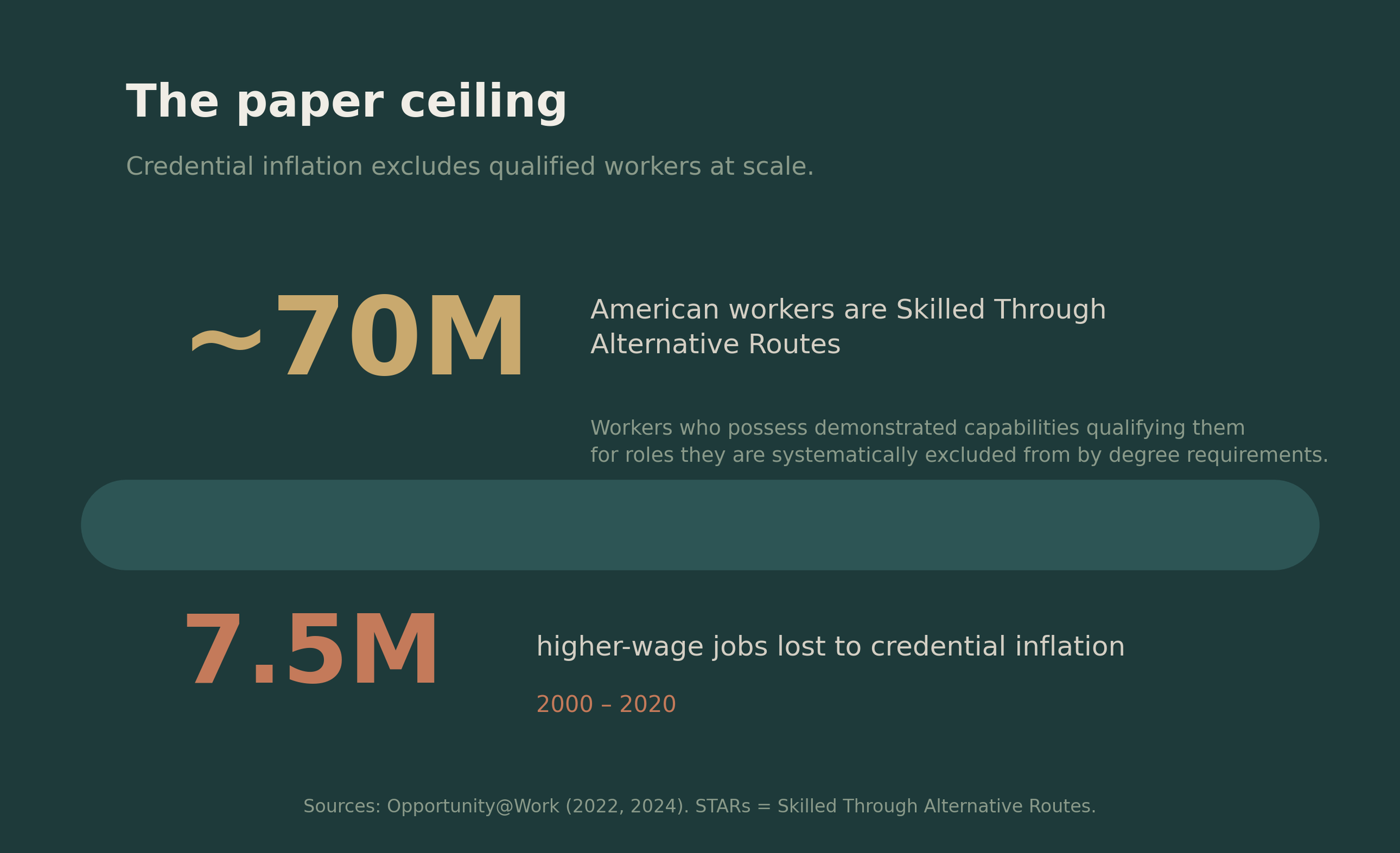
The second is employer skepticism. The degree-requirement reform movement described in the opening of this Commentary reflects a growing recognition among employers that the degree is an unreliable predictor of on-the-job performance for many roles. Research by Opportunity@Work has documented that more than 70 million American workers – those Skilled Through Alternative Routes, or STARs – possess demonstrated capabilities that qualify them for roles they are systematically excluded from by degree requirements (Opportunity@Work, 2024). Between 2000 and 2020, STARs lost access to 7.5 million higher-wage jobs as credential inflation spread (Opportunity@Work, 2022). The "paper ceiling" – the invisible barrier that blocks qualified workers without degrees from economic advancement – is now widely recognized as a structural inefficiency, not merely an individual injustice. The democratic dimension of this is underappreciated, too; credential inflation does not simply exclude capable workers from economic opportunity. It also simultaneously concentrates institutional influence - in courts, regulatory agencies, legislatures, and the civil service - among a narrower and less representative slice of the population. The quality of democratic governance is not independent of who gets to participate in it.
The three pressures of integrity collapse, cost inflation, and employer disengagement are interconnected, and the effects compound. Public confidence in higher education has declined accordingly, with Gallup and the Lumina Foundation documenting a sustained erosion across the past decade (Lumina Foundation and Gallup, 2025). A credential that is simultaneously losing integrity, becoming more expensive, and deprioritized by employers is in structural decline.
The Fallback Problem
When a credible sorting mechanism weakens, the systems that depended on it do not become more open. They fall back on older, less transparent mechanisms.
The labor economics literature on hiring has documented this dynamic extensively. When formal signals lose reliability, employers substitute informal ones: personal networks, referrals, institutional pedigree, and cultural fit judgments that correlate strongly with socioeconomic background (Granovetter, 1973). The substitution is rational at the level of the individual firm – referred hires demonstrably reduce turnover and improve match quality (Burks et al., 2015; Brown, Setren & Topa, 2016) – which is precisely why the reversion will accelerate as the credential weakens. The result is not a more meritocratic labor market but a less legible one – one in which the determining factors of who gets hired are harder to see, harder to challenge, and harder to reform.
This is where the stability argument becomes relevant. Democratic legitimacy depends, in part, on public belief that economic opportunity is allocated through fair and legible processes. Citizens need not believe the system is perfect. However, they do need to believe that effort and capability are meaningfully rewarded, and that the mechanisms for sorting people into opportunities are not rigged in favor of insiders. When "you need to know someone" replaces "you need to qualify" as the felt reality of labor-market entry, the political consequences are predictable: disillusionment, disengagement, and a growing constituency for populist movements that promise to tear down systems perceived as captured by elites.
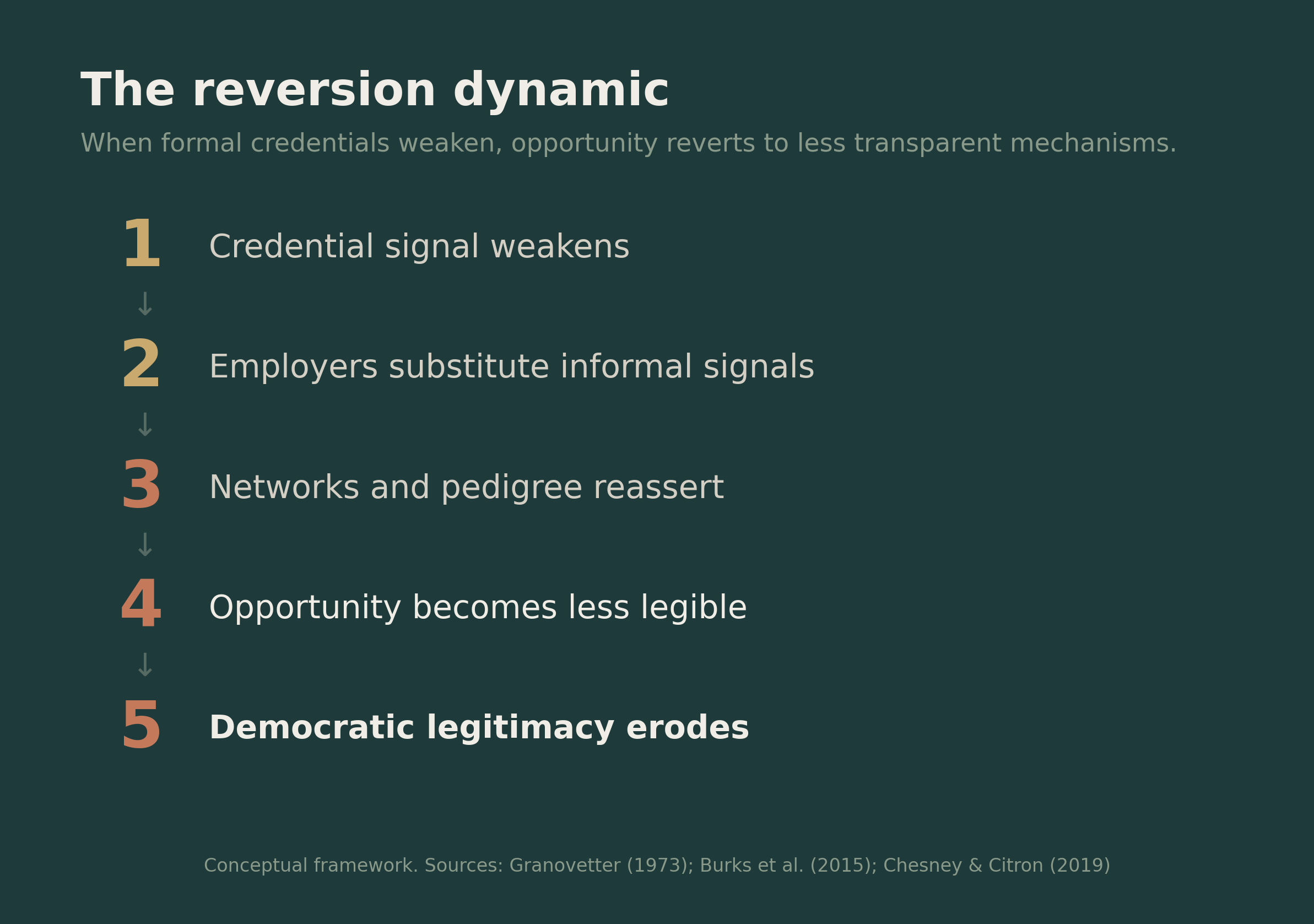
The credential collapse is not the sole driver of this perception – but it is a contributor that is accelerating. A generation of graduates carrying significant debt, holding credentials of uncertain value, and entering a labor market that is simultaneously demanding and skeptical of their qualifications is a generation primed for institutional distrust.
This is the credentialing equivalent of what the deepfake literature calls the "liar's dividend" (Chesney & Citron, 2019): The real damage is not that any particular credential is fraudulent, but that the possibility of fraud degrades trust in all credentials. The parallel to the wider epistemic crisis is useful as understood through another previous GIE Foundation Commentary When Nothing is Trustworthy by Lukas Lyrestam; in the context of synthetic media, the sustainable response to the erosion of trust in a signal is not to police its corruption but to build infrastructure that makes the authentic verifiable (Iorio & Lyrestam, 2025). The same logic applies here. When the mechanisms that anchor shared trust in competence and opportunity degrade, democratic legitimacy goes with them - incrementally but in ways that are very hard to reverse. When employers cannot distinguish the graduate who did the work from the graduate who had AI do it, the rational response is to discount the credential entirely – and to rely instead on signals that are harder to fabricate, such as personal referrals from trusted sources. This is a reversion to pre-meritocratic allocation, and it is already underway.
The Network Factor
Of the three functions the degree has bundled together, the network is the one AI cannot touch. AI erodes trust in the credential because it softens the rigor required to earn it. The network a university produces does not degrade the same way – it is the institution's most durable output. The camaraderie that evolves among students enduring shared challenges leads to marriages, business ventures, and lifelong friendships – and the social capital formed in these settings is among the strongest documented predictors of economic mobility.
Universities have an opportunity to build an artifact-based system that allows students to produce work that matters alongside peers working on the same problems. Left unchecked, this could devolve into the networks, pedigree, and informal access regime of the past, where students without access to capital or power were excluded (Zimmerman, 2019). Instead, universities can help students organically build these connections based on merit and interest. In an artifact-based system, the work itself becomes the social signal: students see what their peers can actually build, and networks form around demonstrated capability rather than pedigree or proximity (Marmaros & Sacerdote, 2006). This is important conceptually for democratic as well as economic reasons. Networks built around demonstrated work are, in principle, more open than those built around institutional affiliation or inherited social capital. Whether that potential is realized depends entirely on whether access to the tools and environments of production is actually equalized - a design requirement, thus, not an automatic outcome.
The International Dimension
The erosion of credential integrity is of course not an exclusively American problem, though many of the issues are on full display there due to the unique costs associated with the U.S. system. Yet its consequences extend beyond domestic labor markets.
Nations whose education systems produce graduates with materially demonstrated capabilities will hold a structural advantage in a globalized economy over those whose systems produce credential-holders of uncertain competence. This is not a theoretical concern. Germany's dual-system apprenticeship model (Berufsausbildung), which combines classroom instruction with hands-on vocational training and culminates in practical examinations, consistently produces workers whose capabilities are verifiable and internationally recognized (Federal Institute for Vocational Education and Training, 2026). Singapore's SkillsFuture initiative has built a national infrastructure for lifelong skills development and certification that is explicitly designed for portability and employer recognition (SkillsFuture Singapore, 2025). China's national vocational qualification framework, while operating under a very different governance model, reflects a deliberate state investment in competency-based credentialing at scale (State Council of the People's Republic of China, 2019).
These systems share a common feature: they assess capability through demonstration, not merely through course completion. A German apprentice earns a credential by producing work that meets professional standards. A Singaporean worker earns a SkillsFuture credit by completing a program with assessed outcomes. The credential certifies what the holder can do, not merely what courses they have attended. Here the institution provisions the environment; the student provides the capability. Studio-based fields do the same – architecture students work in the school's studio, not their parents' office.
The contrast with the dominant American model is rather instructive. The four-year degree certifies attendance and persistence; in an era when the work produced during that attendance can be substantially outsourced to AI, the gap between what the credential certifies and what employers need to know is widening. Nations that close this gap will attract investment, produce more adaptable workforces, and compete more effectively for globally mobile talent in a labor market where demand is shifting decisively toward demonstrable skills (World Economic Forum, 2025). Nations that do not will find their workforce credentials discounted in international markets - a long-term competitiveness liability. Put another way, nations whose education systems produce graduates capable of genuine independent judgment - rather than fluent AI-assisted output - are also producing citizens better equipped to participate in, scrutinize, and sustain democratic institutions. Workforce capability and civic capability are developed through the same processes, and they will degrade through the same flaws and failures.
The Shift from Knowledge Certification to Demonstrated Capability
If the core problem is that AI has severed the link between credential completion and demonstrated competence, then the solution is not to fight AI but to fortify what credentials certify.
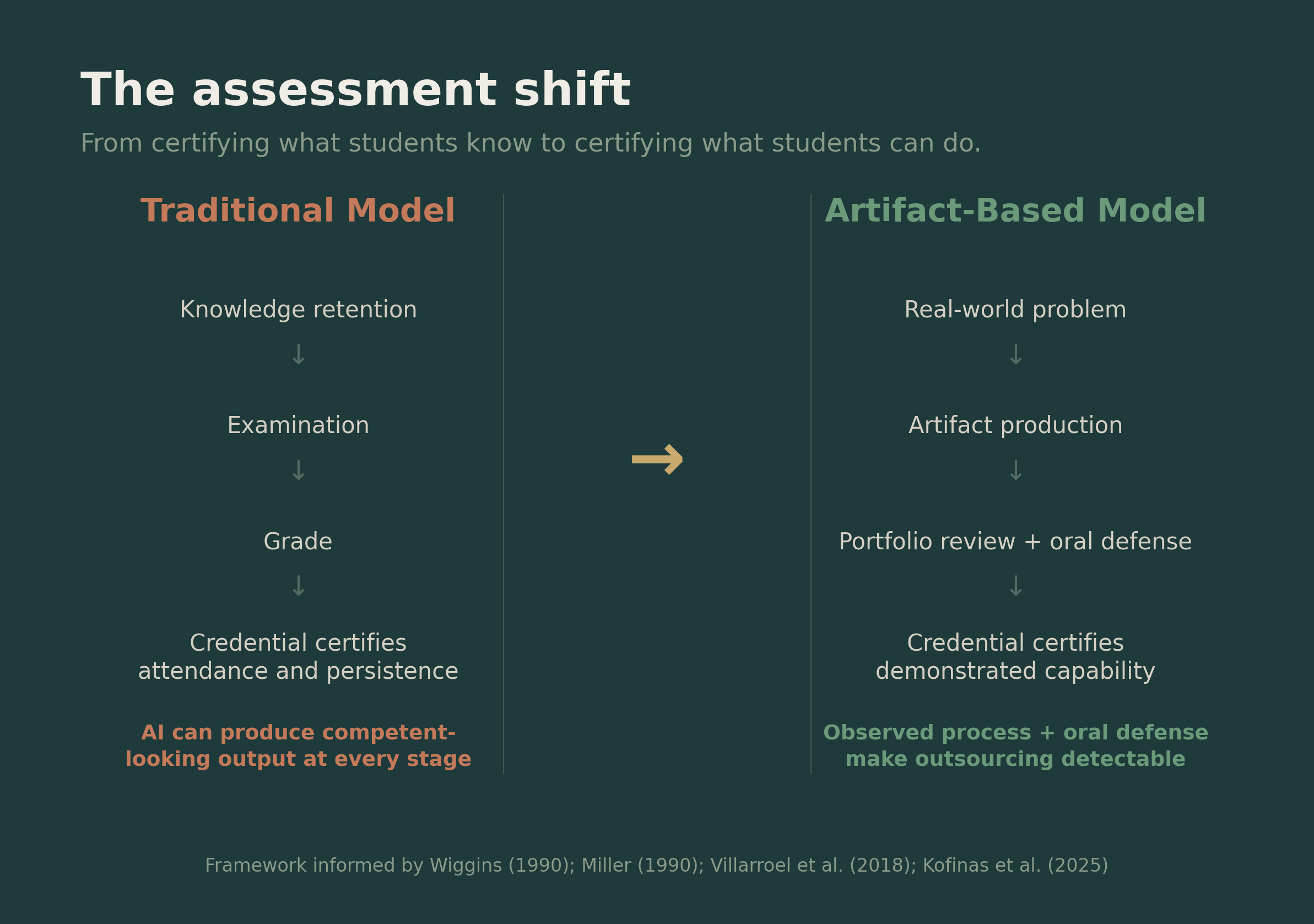
The traditional assessment model in higher education is built around knowledge certification: examinations, essays, problem sets, and other instruments designed to test whether a student has retained and can reproduce information. This model made sense in an era when producing competent-looking work required genuine engagement with the material. It makes less sense in an era when a generative model can produce a passable essay, a working financial analysis, or a functional code snippet in seconds. Testing what a student knows is no longer a reliable proxy for what a student can do, because the tools for converting knowledge prompts into finished outputs are now universally available.
The alternative is an assessment model built around demonstrated capability, what we can call artifact-based education. Under this model, the credential is earned not by passing tests of knowledge retention, but by producing tangible work products that demonstrate the ability to think, create, and solve problems in a given domain. The underlying pedagogical principle – that assessment should mirror the performances the credential claims to certify – has a long lineage in the literature on authentic assessment (Wiggins, 1990; Villarroel et al., 2018).
This is not a new concept. It is already the dominant assessment model in several professional fields. Architecture students earn their credentials in part through design studios and portfolio reviews. Engineering programs culminate in capstone projects that require students to design, build, and test functional systems – a culminating design experience that accreditors formally require (ABET, 2025). Medical students undergo clinical rotations in which they must demonstrate competence with real patients, reflecting medical education's long-standing distinction between what a trainee knows and what a trainee can do (Miller, 1990). Art and design programs have always assessed students through portfolios of completed work. In each of these fields, the credential certifies demonstrated capability because the assessment requires demonstrated capability.
What has not happened, and what the AI integrity collapse now demands, is the extension of this model beyond the fields where it already exists. A business student should earn their credential by building financial models, developing strategic analyses from real data, and presenting recommendations under scrutiny, not by writing essays that a language model could produce. A computer science student should earn their credential by designing, building, and defending working software systems, not by passing multiple-choice examinations on algorithms they may never implement. A communications student should earn their credential by producing published work, managing real campaigns, or building media strategies for actual organizations, not by writing research papers that demonstrate awareness of theory.
The principle is straightforward: in an AI-saturated environment, the only assessment that reliably certifies human capability is one that requires the human to produce something – an artifact – that demonstrates the application of knowledge to a real problem.
This shift does several things simultaneously. It restores the integrity of the credential, because an artifact produced under observed conditions, iterated through feedback, and defended before evaluators is substantially harder to outsource to AI than a take-home essay. It preserves and strengthens the experiential function of the degree, because the process of creating real work products is the developmental experience. The struggle, the iteration, the failure and recovery is what builds professional capability. This work makes the credential more legible to employers, because a portfolio of demonstrated work is a more informative signal than a transcript of grades in courses whose rigor is unknown.
It does not, notably, diminish the value of knowledge, as in the process of building, knowledge remains essential. A student cannot build a sound financial model without understanding accounting principles, cannot design a secure system without understanding threat models, cannot produce a compelling strategic analysis without understanding market dynamics. What changes is the relationship between knowledge and assessment: knowledge that cannot be demonstrated through application has lost its signaling value. Knowledge that can be demonstrated through application and through the creation of artifacts that could not exist without genuine understanding retains and strengthens its value.
What Artifact-Based Education Looks Like
Shifting to an artifact-based model does not require discarding the existing structure of higher education. The artifact-based model elevates it by diversifying what students are asked to produce and how their competence is evaluated.
At the curriculum level, programs would be redesigned around the production of domain-relevant artifacts rather than the completion of knowledge-testing assessments. A finance program would require students to build working financial models, conduct real due diligence analyses, and construct investment theses defended before panels of practitioners. A cybersecurity program would require students to produce threat models, design security architectures, and conduct assessed penetration tests against controlled environments. A journalism program would require students to produce published investigative pieces, not simulated ones. A data science program would require students to produce analyses of real datasets with documented methodology and defensible conclusions.
At the assessment level, the emphasis shifts from examinations to portfolio review and defense. Students accumulate a body of work over the course of their program. These artifacts demonstrate not just knowledge but the ability to apply knowledge to ambiguous, real-world problems. Capstone projects, are already common in engineering and some business programs and long identified as a high-impact educational practice (Kuh, 2008), would become the norm across disciplines rather than the exception. Assessment would include oral defense, where students explain their reasoning, respond to challenges, and demonstrate that they understand the work they have produced - a format that the assessment literature consistently identifies as both resistant to AI substitution and developmental in its own right (Sotiriadou et al., 2020).
The defense component is not optional. The experimental evidence is blunt on this point: artifacts alone are gameable, because evaluators cannot reliably distinguish AI-assisted work from independent work on inspection of the output (Kofinas et al., 2025). The integrity of the model rests on the observed process and the oral defense - on assessing how the work was produced and whether the student can stand behind it - not on the polish of the artifact itself.
At the institutional level, this shift requires investment in faculty development, studio and lab infrastructure, and industry partnerships that provide access to real-world problems and data. It also requires a willingness to move away from the lecture-and-exam model that currently dominates many programs – a model that is efficient for institutions but increasingly ineffective as a mechanism for certifying true capability.
None of this is technologically exotic. The pedagogical frameworks exist. The assessment methods exist. What has been missing is the urgency to adopt them at scale. Now AI provides that urgency.
Limits and Risks
Intellectual honesty requires acknowledging the limitations of this proposal.
Artifact-based assessment is more resource-intensive than traditional examination. It requires smaller class sizes, more faculty time per student, and infrastructure that many institutions – particularly under-resourced community colleges and public universities – may struggle to fund. Any reform agenda that ignores this cost reality will fail at scale. Funding models, including public investment in assessment infrastructure, will need to accompany curricular reform.
There is a risk that artifact-based assessment introduces new forms of inequity. The concern is empirically grounded: access to high-impact practices such as capstones and applied projects is already unequally distributed across student populations (Finley & McNair, 2013). Students with access to better tools, better mentorship, and more professional networks will produce stronger artifacts, potentially reproducing existing advantages through a different mechanism. Program design must account for this by ensuring that assessment evaluates capability relative to resources available, and by providing equitable access to the tools and environments needed to produce quality work. Networks formed around demonstrated work are more accessible than networks formed around tuition, proximity, and family connection, provided institutions equalize access to the tools of production.
The "teach to the test" dynamic does not disappear; but it would transform, in a sense. If artifacts become the credential, students will optimize for artifact production rather than deep learning, just as they currently optimize for grades. This risk is real but mitigable: well-designed artifact-based programs emphasize process, iteration, and defense alongside final output, making it harder to game the system by producing a polished surface without underlying substance.
Faculty resistance is likely and should not be dismissed. Many academics were trained in and are committed to the knowledge-transmission model of education. Shifting to an artifact-based model requires not just new assessment methods but a different conception of the faculty role – from lecturer to coach, from examiner to evaluator of work in progress. This is a cultural shift, and it will take time.
Finally, not all domains lend themselves equally to artifact-based assessment. Foundational subjects – mathematics, basic sciences, introductory philosophy – may still require some form of knowledge testing alongside applied work. The proposal is not that artifact-based assessment replaces all other forms, but that it becomes the primary basis for credentialing in professional and applied programs, and a significant component in all others.
Policy Recommendations
Shifting from knowledge certification to demonstrated capability is not a reform that individual institutions can accomplish alone. It requires coordinated action across the ecosystem that shapes what education looks like, what it costs, and what employers accept. The argument of this Commentary is ultimately about institutional trust. Credentialing systems are one of the primary mechanisms through which democratic societies make the allocation of opportunity recognizable and meritocratic. Following are reforms that hope to restore the integrity of that mechanism to serve democratic stability directly.
Recommendation 1: Accreditation bodies should revise standards to recognize and incentivize artifact-based assessment. Current accreditation frameworks often emphasize input metrics - credit hours, seat time, faculty credentials - over outcome metrics that measure demonstrated student capability. Reforming these standards to weight portfolio-based assessment, capstone performance, and demonstrated competency alongside traditional metrics would create institutional permission and incentive for curricular reform. Accreditation standards should also address AI integrity directly, requiring institutions to demonstrate that their assessment methods can distinguish genuine student capability from AI-assisted output.
Recommendation 2: Government funding agencies should tie public investment to assessment models that certify demonstrated capability. This does not mean mandating a single pedagogical approach; it means conditioning a portion of federal and state funding on evidence that institutions are moving toward assessment methods resilient to AI substitution. Grant programs supporting the development of artifact-based curricula, faculty retraining, and the infrastructure needed for studio and lab-based education would accelerate adoption. Existing workforce development funding should prioritize programs that credential through demonstrated work product rather than course completion alone.
Recommendation 3: Employers should develop and publish competency frameworks describing the artifacts and capabilities they value in entry-level hires. The private sector has already begun moving away from degree requirements. The next step is to articulate clearly what they are moving toward - not generic "skills" lists, but specific work products that signal readiness: a working financial model, a security assessment, a portfolio of published analysis, a functioning application. By making these expectations explicit, employers give educational institutions a concrete target for curricular reform and give students without degrees a legible pathway to demonstrating equivalent capability.
Recommendation 4: Higher education institutions should redesign programs around the production of domain-relevant artifacts. This requires investment in faculty development, assessment infrastructure, and industry partnerships. It also requires institutional courage, a willingness to move away from models that are efficient for the institution but no longer effective for the student or the employer. Institutions that make this shift early will differentiate themselves in an increasingly skeptical market; those that do not will find their credentials progressively discounted.
Recommendation 5: International and multilateral bodies should develop frameworks for the mutual recognition of competency-based credentials across borders. As labor markets globalize, the portability of credentials becomes a strategic concern. A demonstrated-capability credential earned in one OECD nation should be legible and recognizable in another. UNESCO's Global Convention on the Recognition of Qualifications concerning Higher Education, in force since 2023, provides an institutional foundation on which competency-based recognition standards could be built (UNESCO, 2019). This requires agreed-upon standards for what "demonstrated capability" means in key professional domains. These standards must be open, interoperable, and not captured by any single national system or commercial interest.
Closing
The four-year degree was never a perfect instrument. It was, however, a functional one – a socially accepted mechanism for sorting capability into opportunity at scale, imperfect but broadly legible and broadly trusted. That functionality is degrading, as we have shown, and the degradation has a specific, identifiable accelerant: Generative AI, which has weakened and threatens to destroy the link between credential completion and demonstrated competence.
The stakes here are very wide: They reach into the question of what kind of citizens democratic societies are producing, and whether the institutions meant to develop human capacity are doing so. The erosion of credentialing integrity is a driver of institutional distrust, and institutional distrust is one of the most consequential and least reversible forms of democratic fragility.
The instinct to fight this by policing AI use – by building better detection tools, by banning chatbots from classrooms, by escalating the arms race between students and proctors – will fail for the same reason that content-policing approaches to synthetic media are failing: the asymmetry between production and detection is structural, and it favors the producer. As Iorio and Lyrestam have argued in the context of media integrity, the sustainable response is not to try to prevent the creation of inauthentic content, but to build infrastructure that makes authentic content verifiable (Iorio & Lyrestam, 2025). The parallel in education is precise: The sustainable response is not to try to prevent AI-assisted coursework, but to shift assessment to formats in which genuine human capability is demonstrable and verifiable.
Artifact-based education – curricula built around the creation of real work products, assessed through portfolio review and oral defense, designed to certify what a person can do rather than what they can recall – is that shift. It is not a speculative proposal. It is already the dominant model in architecture, engineering, medicine, and the creative arts. What the AI moment demands is its extension to the rest of higher education, supported by accreditation reform, public investment, employer engagement, and international coordination.
The stakes are not merely pedagogical; indeed, when the dominant mechanism for allocating economic opportunity loses public trust, the fallback is a less transparent mechanism. Networks, pedigree, and informal access reassert themselves - or put another way, meritocracy will die. The perception that opportunity is allocated fairly gives way to the conviction that the system is rigged. This is a stability problem – for labor markets, for democratic legitimacy, and for the social contract that holds both (and all of us) together.
The future of education is not and indeed was never the regurgitation of knowledge that a machine can retrieve in seconds. What it must be is teaching people to think and create. That is the credential that will survive the AI era, and building the systems to issue it is now urgent, lest we lose our ability to educate entirely.
References
ABET (2025) Criteria for accrediting engineering programs, 2025–2026. ABET. [Available here]
Belkin, D. (2023) 'Americans are losing faith in college education, WSJ-NORC poll finds', The Wall Street Journal.
Brown, M., Setren, E. and Topa, G. (2016) 'Do informal referrals lead to better matches? Evidence from a firm's employee referral system', Journal of Labor Economics, 34(1), pp. 161–209.
Burks, S.V., Cowgill, B., Hoffman, M. and Housman, M. (2015) 'The value of hiring through employee referrals', Quarterly Journal of Economics, 130(2), pp. 805–839.
Burning Glass Institute (2022) The Emerging Degree Reset: How the Shift to Skills-Based Hiring Holds the Keys to Growing the U.S. Workforce. Burning Glass Institute.
Caplan, B. (2018) The Case Against Education: Why the Education System Is a Waste of Time and Money. Princeton University Press.
Chesney, R. and Citron, D.K. (2019) 'Deep fakes: A looming challenge for privacy, democracy, and national security', California Law Review, 107(6), pp. 1753–1820.
Chetty, R., Jackson, M.O., Kuchler, T., Stroebel, J. et al. (2022) 'Social capital I: Measurement and associations with economic mobility', Nature, 608, pp. 108–121.
Cicero Institute (n.d.) Expanding public sector career opportunities. Cicero Institute. [Available here]
Caminiti, S. (2022) 'No college degree? No problem. More companies are eliminating requirements to attract the workers they need', CNBC, 25 April.
Commonwealth of Pennsylvania (2024) Governor Shapiro Gets Stuff Done: Giving Pennsylvanians the Freedom to Chart Their Own Course. Press release. Commonwealth of Pennsylvania.
Cooper, P. (2025) 'State governments could do more to hire for skills, not degrees', American Enterprise Institute.
Debroy, P. and Auguste, B. (2025) 'Using AI to advance skills-first hiring', Brookings, 8 July. [Available here]
Federal Institute for Vocational Education and Training (ed.) (2026) VET Data Report Germany 2023: Facts and analyses to accompany the Federal Government Report on Vocational Education and Training – Selected findings. Bonn. [Available here]
Federal Student Aid (2026) Federal student aid posts updated reports to FSA data center (GENERAL-26-15). U.S. Department of Education, 13 March. [Available here]
Finley, A. and McNair, T. (2013) Assessing Underserved Students' Engagement in High-Impact Practices. Association of American Colleges and Universities.
Freeman, J. (2025) Student Generative AI Survey 2025 (Policy Note 61). Higher Education Policy Institute, 26 February. [Available here]
Fuller, J.B. and Raman, M. (2017) Dismissed by Degrees: How Degree Inflation Is Undermining U.S. Competitiveness and Hurting America's Middle Class. Harvard Business School / Accenture / Grads of Life.
Granovetter, M. (1973) 'The strength of weak ties', American Journal of Sociology, 78(6), pp. 1360–1380.
Illingworth, S. (2026) 'Reclaiming human skills as core skills in the age of AI', GIEF Commentary, 15 June. [Available here]
Iorio, B. and Lyrestam, L. (2025) 'When nothing is trustworthy: AI, transparency, and democracy', GIEF Commentary. [Available here]
Lumina Foundation and Gallup (2025) The state of higher education 2025: Demand for higher education remains strong despite barriers. Lumina Foundation, 2 May. [Available here]
Kofinas, A.K., Tsay, C.-H. and Pike, D. (2025) 'The impact of generative AI on academic integrity of authentic assessments within a higher education context', British Journal of Educational Technology, 56(6), pp. 2522–2549. [Available here]
Kuh, G.D. (2008) High-Impact Educational Practices: What They Are, Who Has Access to Them, and Why They Matter. Association of American Colleges and Universities.
Liang, W., Yuksekgonul, M., Mao, Y., Wu, E. and Zou, J. (2023) 'GPT detectors are biased against non-native English writers', Patterns, 4(7), article 100779. [Available here]
Ma, J., Pender, M. and Hu, X. (2025) Trends in college pricing and student aid 2025. College Board. [Available here]
Marmaros, D. and Sacerdote, B. (2006) 'How do friendships form?', Quarterly Journal of Economics, 121(1), pp. 79–119.
Merriam-Webster (n.d.) 'Accrediting', in Merriam-Webster.com dictionary. Retrieved 15 June 2026.
Miller, G.E. (1990) 'The assessment of clinical skills/competence/performance', Academic Medicine, 65(9), pp. S63–S67.
OECD (2010) Learning for Jobs: OECD Reviews of Vocational Education and Training. OECD Publishing.
OpenAI (2023) New AI classifier for indicating AI-written text [classifier subsequently discontinued due to low accuracy]. OpenAI.
Opportunity@Work (2022) Tear the Paper Ceiling: About STARs. Opportunity@Work.
Opportunity@Work (2024) The State of the Paper Ceiling. Opportunity@Work.
SkillsFuture Singapore (2025) Annual report FY2024/2025: Shaping the next chapter – building skills, growing careers. SkillsFuture Singapore. [Available here]
Sotiriadou, P., Logan, D., Daly, A. and Guest, R. (2020) 'The role of authentic assessment to preserve academic integrity and promote skill development and employability', Studies in Higher Education, 45(11), pp. 2132–2148.
State Council of the People's Republic of China (2019) National Vocational Education Reform Implementation Plan. State Council of the People's Republic of China.
The White House (2020) Executive Order on Modernizing and Reforming the Assessment and Hiring of Federal Job Candidates. The White House.
Tyton Partners (2024) Time for Class 2024: Unlocking Access to Effective Digital Teaching and Learning. Tyton Partners.
Tyton Partners and D2L (2025) Time for Class 2025. Tyton Partners and D2L.
UNESCO (2019) Global Convention on the Recognition of Qualifications concerning Higher Education. UNESCO, 25 November. [Available here]
Villarroel, V., Bloxham, S., Bruna, D., Bruna, C. and Herrera-Seda, C. (2018) 'Authentic assessment: Creating a blueprint for course design', Assessment & Evaluation in Higher Education, 43(5), pp. 840–854.
Wiggins, G. (1990) 'The case for authentic assessment', Practical Assessment, Research & Evaluation, 2(2).
World Economic Forum (2025) The Future of Jobs Report 2025. World Economic Forum.
Zimmerman, S.D. (2019) 'Elite colleges and upward mobility to top jobs and top incomes', American Economic Review,